
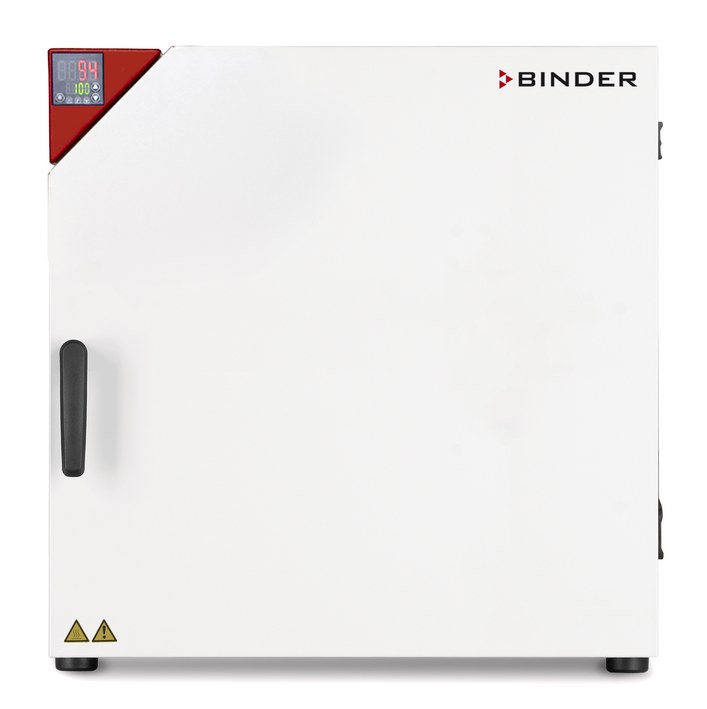
BINDER BD-S 115
BINDER BD-S 115 — Incubators with Temperature 5…70 °C.
The BD-S 115 is a 118 L natural-convection incubator with a stainless steel 1.4016 (AISI 430) interior and a polyester-coated RAL 9003 housing, controlled by an R-S PID controller with 0.1 °C display resolution. It covers 5–70 °C with 0.3 K fluctuation and 0.5 K uniformity, and is distinguished from the BD-S 56 sibling by its larger chamber volume. It is intended for incubation of cultures at a standard 37 °C set-point.
Direct drop-in replacements
BINDER BD-S Series — Model Comparison & Selection
| Model | Temperature, °C | Depth, cm | Height, cm | Interior volume, L | Interior width, mm | Load per rack, kg |
|---|---|---|---|---|---|---|
| BD-S 115 Current | 5–70 | 61.6 | 73.5 | 118 | 550 | 20 |
| BD-S 56 | 5–70 | 57.7 | 62.5 | 62 | 400 | 15 |
Full specifications
| Temperature | 5...70 °C |
| Interior volume | 118 L |
| Load per rack | 20 kg |
| Nominal power | 0.35 kW |
| Permitted load | 75 kg (BDS115-230V / BDS115UL-120V) |
| Temperature fluctuation | 0.3 K |
| Temperature uniformity | 0.5 K |
| Back wall clearance | 160 mm (BDS115-230V / BDS115UL-120V) |
| Side wall clearance | 100 mm (BDS115-230V / BDS115UL-120V) |
| Article Number mfr | 9090 |
| Recovery time after door was opened for 30 s at 37°C mfr | 15 min |
| Depth | 616 mm (BDS115-230V / BDS115UL-120V) |
| Height | 735 mm (BDS115-230V / BDS115UL-120V) |
| Interior width | 550 mm (BDS115-230V / BDS115UL-120V) |
| Width | 765 mm (BDS115-230V / BDS115UL-120V) |
| Net weight of the unit (empty) mfr | 47 kg |
| Power frequency | 50 Hz |
| Rated voltage | 230 V |
| Unit fuse | 6.3 A |
| Phase (Nominal voltage) mfr | 1 |
Description
Construction and series positioning
- The BD-S 115 is the 118 L member of the Solid.Line BD-S incubator series; the sibling BD-S 56 shares the same 5–70 °C working range but a smaller chamber.
- Interior and door interior are stainless steel 1.4016 (AISI 430); the housing is polyester-coated RAL 9003.
- Natural convection (no forced-air fan) distinguishes BD-S from the FD-S forced-convection ovens in the same manual family.
- Overtemperature protection is class 1 per DIN 12880:2007 as standard, with a class 3.1 safety controller on BD-S (class 2 applies to ED-S/FD-S ovens).
- Temperature display resolution is 0.1 °C on BD-S, versus 1 °C on ED-S/FD-S.
Behaviour under load and in operation
- Working range 5–70 °C; temperature fluctuation 0.3 K and uniformity 0.5 K.
- Recovery time after a 30 s door opening at 37 °C is 15 min.
- Load per rack is limited to 20 kg.
- The chamber has no explosion protection; charging materials must be harmless and the operating temperature must remain below their flash or sublimation point.
- Stainless steel 1.4016 is not resistant to acids or halides; corrosive charging materials can damage the interior and are excluded from liability.
Installation, connection and control
- The R-S microprocessor PID controller sits on the triangular instrument panel with a digital display and functional buttons; set-point entry, °C/°F unit selection, and a delayed-off timer are menu functions.
- Air change rate is adjusted via the exhaust air flap.
- The 230 V variant (Art.-No. 9090-0022) uses a CEE 7/7 grounded plug, 1N~ current type, and a 6.3 A chamber fuse; the UL 120 V variant (Art.-No. 9090-0023) uses a NEMA 5-15P plug and 12.5 A fuse.
- Nominal voltage tolerance is ±10 % at the indicated power frequency.
- The chamber must not be installed in unventilated recesses; prescribed minimum distances and sufficient ventilation for heat dispersal apply.
- Lift at the four lower corners with two people; never lift or transport by the door handle or door.
Integration & Operating Notes
The type plate tolerance is ±10 % at the indicated power frequency (230 V / 50 Hz or 60 Hz). Verify mains quality before installation; out-of-tolerance supply can affect controller operation and heating performance. Size the branch circuit for the 6.3 A chamber fuse on 230 V models.
The chamber has no explosion protection measures. Do not introduce combustible or explosive substances, and confirm that the operating temperature lies below the flash point or sublimation point of the charging material. Acids and halides can also corrode the 1.4016 stainless steel interior.
BD-S incubators carry a class 3.1 safety controller per DIN 12880 in addition to the standard class 1 overtemperature device. Set the safety controller set-point and confirm alarm response before loading the chamber; the class differs from ED-S/FD-S ovens (class 2), so do not transfer settings between chamber types.
Plan regular maintenance at least once a year, plus an annual repeat electrical inspection and tests before initial start-up and after maintenance or repair, recommended per EN 50678/VDE 0701 and EN 50699/VDE 0702. Disconnect the power plug before maintenance; do not remove the rear panel; the chamber must not become wet.
Hot gasket replacement may damage the gasket. Allow the chamber to cool before replacing the door gasket, and keep the chamber dry during maintenance to avoid electrical hazard from water ingress.
Permissible transport and storage ambient is -10 °C to +60 °C with max. 70 % r.h. non-condensing. After storage in a cold location, wait at least one hour at ambient temperature until the chamber is completely dry before start-up, to prevent condensation-related electrical hazard.
Selection & Integration Q&A
Pick the BD-S 115 when the 118 L chamber and 20 kg per-rack load are needed at 5–70 °C with 0.1 °C display resolution and natural convection. The BD-S 56 shares the same temperature range but a smaller chamber. Choose FD-S only if forced-air circulation is required; BD-S is the incubator line for 37 °C culture work.
The 230 V variant (Art.-No. 9090-0022) uses a CEE 7/7 grounded plug, 1N~ current type, and a 6.3 A chamber fuse; supply must stay within ±10 % of nominal at the rated frequency. The UL 120 V variant (Art.-No. 9090-0023) uses a NEMA 5-15P plug with a 12.5 A chamber fuse.
Do not install in unventilated recesses; observe the prescribed minimum distances and provide sufficient ventilation for heat dispersal. Transport/storage ambient is -10 °C to +60 °C at max. 70 % r.h. non-condensing, and after cold storage wait at least one hour before start-up. Lift at the four lower corners with two people, never by the door.
Regular maintenance at least once a year, plus annual repeat electrical inspection per EN 50678/VDE 0701 and EN 50699/VDE 0702, including before initial start-up and after repair. Disconnect the plug before service; replace the door gasket only when cold. Racks and accessories are separate items; the base unit ships without them.