
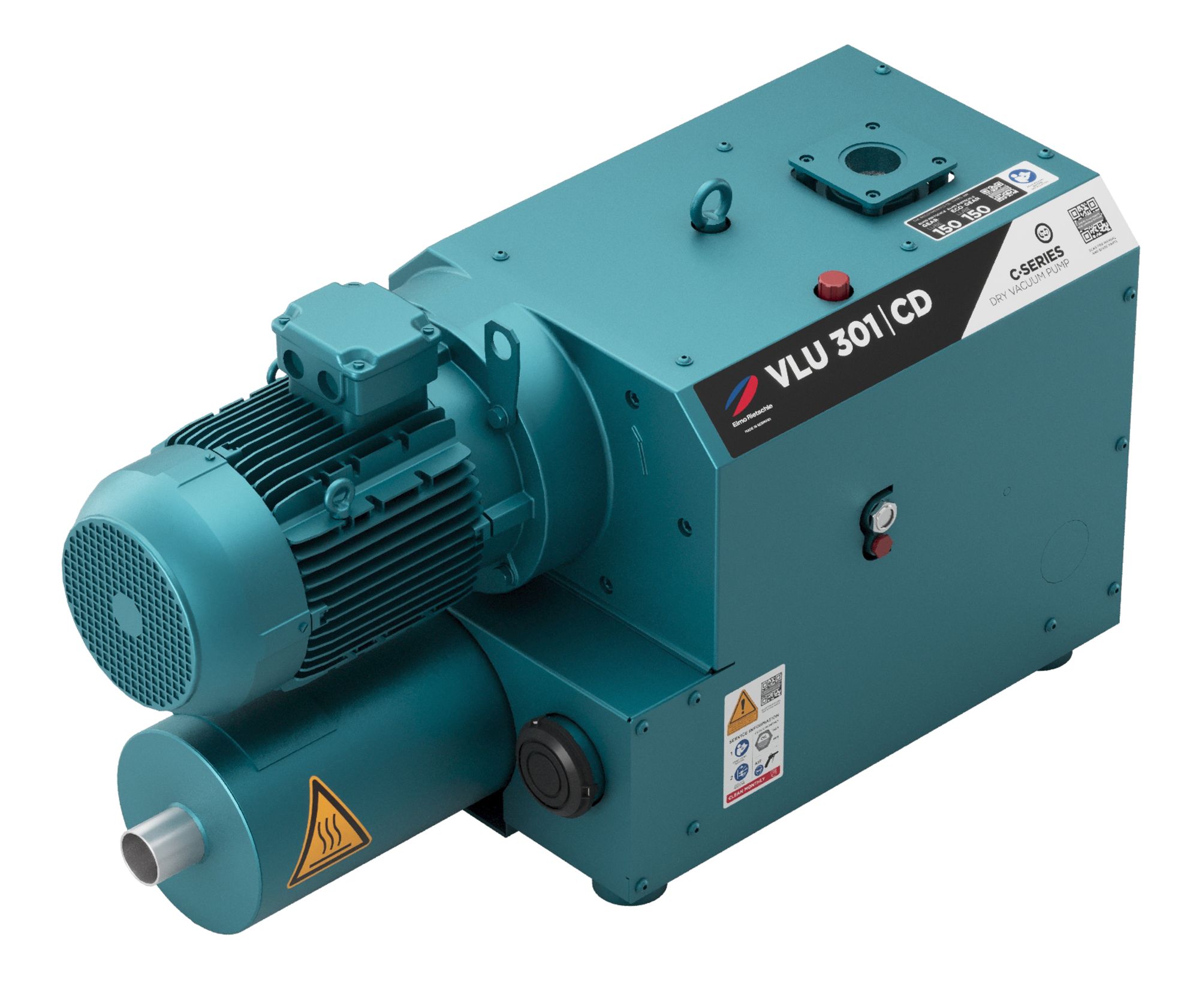
Elmo Rietschle C-VLU 401
Elmo Rietschle C-VLU 401 — Claw Vacuum Pumps.
The C-VLU 401 is a contact-free, dry-running claw vacuum pump with oil-lubricated timing gears, driven by a flanged three-phase standard motor. It delivers 380 m³/h free-suction capacity at 50 Hz and sustains continuous operation from 700 mbar (abs.) down to 60 mbar (abs.) inlet pressure, distinguishing it within the C-VLU series by its mid-range displacement between the 301 and 501/651 sizes. It serves as a dry, oil-free process vacuum source in systems where the exhaust can be kept below +30 mbar back pressure and pressure monitoring is provided by the operator.
Elmo Rietschle C-VLU Series — Model Comparison & Selection
Full specifications
Description
Construction and series positioning
- Double-shaft rotary claw principle: two rotors run contact-free and dry in the pumping chamber, synchronised by an oil-lubricated gear pair isolated from the process gas.
- Standard version (CD) is supplied without a condensate drain; the XD variant of the same size adds a corrosion-protective coating and a silencer condensate drain for water-damp gases.
- Within the C-VLU series the 401 sits between the smaller C-VLU 301 (265 m³/h, 30 mbar ultimate) and the larger 501/651 sizes; its 380 m³/h free-suction figure at 50 Hz is the sizing basis for this model.
- Drive is a flanged three-phase standard motor to DIN EN 60034, IP 55, insulation class F; cooling is by an insulation hood and drum fan.
Behaviour across the working range
- Continuous operation is permitted at any inlet pressure between 700 mbar (abs.) and 60 mbar (abs.); the free-suction pumping speed of 380 m³/h at 50 Hz is the reference point, with actual capacity following the characteristic curve in data sheet D 893 as inlet pressure falls.
- The exhaust side is the binding constraint: maximum permissible back pressure is +30 mbar, and the exhaust opening must never be closed or restricted.
- Ambient and inlet temperatures must stay between 5 °C and 40 °C; output reduction becomes noticeable above 1000 m above sea level.
- Surface temperatures above 70 °C occur in operation, so hot parts must be guarded.
Installation, connection and control
- The pump must stand horizontally with no more than 8° inclination in any direction, on a level load-bearing floor, secured against tipping.
- Cooling air inlets and outlets need at least 30 cm clearance from walls; at least 50 cm free space is required around the machine for maintenance access to the oil filling point, sight glass and drain.
- Pipes are screwed in by hand only, with flexible connections where necessary; blind plugs and adhesive film must be removed from vacuum and exhaust connections before commissioning.
- Electrical installation per EN 60204 by a qualified electrician; the user supplies the main switch and motor protection switch. Motors above the stated apparent-power or start-current limits are not suitable for direct-on-line starting.
- Pressure monitoring is mandatory but not factory-fitted: the operator must install a system that switches the pump off or brings it to a safe state if pressure falls below the minimum permissible final pressure on the rating plate. No integral emergency stop is provided; it must come from the operator's protection concept.
Integration & Operating Notes
Any silencer, pipe run or downstream treatment that raises exhaust pressure above +30 mbar exceeds the permissible limit and requires consultation with the manufacturer; liquids must not be allowed to accumulate in the exhaust line, and the exhaust opening must never be closed or restricted.
No pressure monitoring is fitted at the factory and operation without it is not permitted. The operator must install a switch that shuts the pump down or moves it to a safe state when pressure falls below the minimum permissible final pressure on the rating plate, set with the ±5 % pressure tolerance in mind.
AC motors with apparent output above 1.7 kVA, three-phase motors above 5.2 kVA, or motors with start currents above 60 A are not designed for direct start on the network; use star-delta starting, a smooth starter or a frequency converter to limit mechanical load at start. Supply tolerances are ±5 % voltage and ±2 % frequency.
Before decommissioning or any shutdown exceeding 2 hours, run the pump at 500 mbar (abs.) for at least 15–30 minutes with dry air to remove moisture and pollution; otherwise condensate and deposits can adhere to rotors and casing and prevent restart. Oil level must be checked at the sight glass before commissioning.
Selection & Integration Q&A
Pick the 401 when the duty needs about 380 m³/h free suction at 50 Hz within 700–60 mbar (abs.). The 301 is smaller at 265 m³/h with 30 mbar ultimate; the 501/651 cover 495/600 m³/h. Choose the XD version of the 401 only if the gas is water-damp.
A qualified electrician must wire it per EN 60204 with a user-supplied main switch and motor protection switch. Motors above 1.7 kVA (AC) or 5.2 kVA (three-phase) or with start current over 60 A need star-delta, soft start or a frequency converter. A pressure monitor that trips below minimum final pressure is mandatory and not factory-fitted.
Base delivery excludes the intake filter (paper or polyester option), pressure monitoring and main/motor protection switches. Check oil at the sight glass before start-up and top up as needed; before any stop over 2 hours run at 500 mbar with dry air for 15–30 min. Spare parts are listed per model in the VLU 401/501/651 spare parts list.