
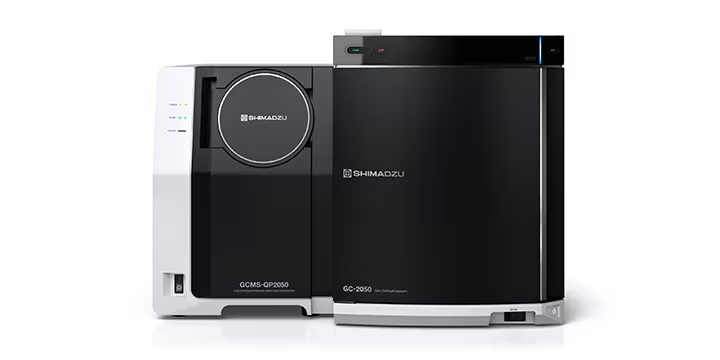
Shimadzu GC-MS Qp2050
Shimadzu GC-MS Qp2050 — Mass spectrometers.
The GCMS-QP2050 is a single-quadrupole GC-MS with a DuraEase ion source, long-life filament, and maintenance-free pre-rod quadrupole. It delivers 30,000 u/sec scan speed and supports hydrogen or nitrogen carrier gas, with robustness below 18.8 %RSD over 64 pesticides. It serves routine food-safety and environmental screening where uptime and low maintenance dominate.
Direct drop-in replacements
Full specifications
| Carrier gas | Hydrogen, Nitrogen (alternative carrier gases) |
| Detector types | latest noise suppression technology and high amplification performance (GCMS-QP2050) |
| Injection modes | Split, Splitless, PTV, Large Volume, Direct, Thermal Desorption (Multi-Mode Injection Unit (MMI)) |
| Ion source | DuraEase (GCMS-QP2050) |
| Scan speed | 30000 u/sec (GCMS-QP2050) |
| Robustness (%RSD) mfr | < 18.8 % (continuous analysis of 64 pesticides in food matrices) |
| Quadrupole mfr | with pre-rod, maintenance-free (GCMS-QP2050) |
| Filament replacement frequency mfr | 1/5th the conventional replacement frequency (long-life filament) |
| Filament operating life mfr | at least five times longer than conventional fil (long-life filament) |
Description
Construction and series positioning
- Single-quadrupole mass spectrometer with a DuraEase ion source designed for easy maintenance and a quadrupole with pre-rod that requires no routine cleaning.
- Long-life filament rated for at least five times conventional operating life, reducing replacement frequency to one-fifth.
- No sibling variants are listed; this model is the base platform in the QP2050 series.
Behavior under load and media
- Scan speed up to 30,000 u/sec supports fast GC methods and narrow peaks.
- Compatible with hydrogen or nitrogen carrier gas as alternatives to helium.
- In continuous analysis of 64 pesticides in food matrices, retention-time and response %RSD remained below 18.8, indicating stability for extended sequences.
- The Multi-Mode Injection Unit (MMI) supports Split, Splitless, PTV, Large Volume, Direct, and Thermal Desorption injection modes, allowing method flexibility without hardware change.
Installation, connection, and operation
- The brochure describes the platform with compatible peripherals: HS-20 NX headspace sampler, TD-30 thermal desorption system, AOC-6000 Plus autosampler, and LabSolutions CS/DB software.
- No electrical, dimensional, or environmental installation limits are printed in the available digest; consult the instruction manual for supply, gas, and bench requirements.
- Detector uses noise-suppression technology and high amplification; no user-adjustable detector parameters are documented in the digest.
Integration & Operating Notes
Hydrogen and nitrogen are listed as alternative carrier gases. Switching from helium requires re-optimizing flow, oven ramp, and injection parameters, and may affect detector response; verify method performance with the intended gas before routine use.
The HS-20 NX headspace sampler, TD-30 thermal desorption system, AOC-6000 Plus autosampler, and LabSolutions CS/DB software are described as compatible options. Confirm ordering scope: base delivery may not include autosampler, cables, or software licenses.
The <18.8 %RSD figure applies to continuous analysis of 64 pesticides in food matrices. Other matrices, analytes, or extended sequences may show different drift; run an initial system suitability check before adopting the method for routine work.
Selection & Integration Q&A
No sibling variants are listed, so the QP2050 is the base platform. Choose it when you need 30,000 u/sec scan speed, hydrogen/nitrogen carrier gas compatibility, and low-maintenance DuraEase source with long-life filament for routine screening.
The base instrument requires a GC and carrier gas supply. Optional peripherals include HS-20 NX headspace sampler, TD-30 thermal desorption system, AOC-6000 Plus autosampler, and LabSolutions CS/DB software; confirm whether autosampler and software are included in your order.
The available brochure digest does not print electrical, dimensional, or environmental limits. For continuous sequences, the validated robustness is <18.8 %RSD over 64 pesticides; consult the instruction manual for supply, gas, and bench requirements before installation.
The long-life filament needs replacement at one-fifth the conventional frequency; the pre-rod quadrupole is maintenance-free. Plan source cleaning per manual. Autosampler, headspace sampler, thermal desorption unit, software, and cables are options, not base delivery.