
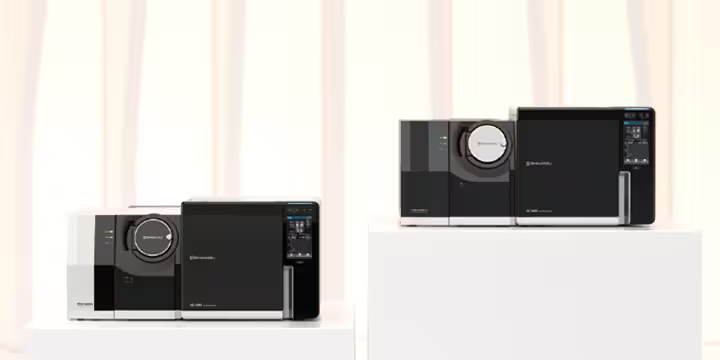
Shimadzu GC-MS TQ RX Series
Shimadzu GC-MS TQ RX Series — Mass spectrometers.
The GCMS-TQ RX Series is a triple quadrupole GC-MS that also operates in single quad mode, using a Boosted Efficiency Ion Source (BEIS) or Smart EI/CI source for femtogram-level sensitivity. It supports hydrogen, nitrogen, or helium carrier gas and a Multi-Mode Injection Unit with split, splitless, PTV, large volume, direct injection, and thermal desorption. This configuration serves targeted quantitation in complex matrices where both MS/MS selectivity and single-quad survey capability are required.
Direct drop-in replacements
Full specifications
| Sensitivity | femtogram level (GCMS-TQ RX Series) |
| Type | Triple quadrupole GC-MS (GCMS-TQ RX Series) |
| Carrier gas | Hydrogen, nitrogen, helium (GCMS-TQ RX Series) |
| Configuration | Triple quadrupole with single quad GC-MS mode capability (GCMS-TQ RX Series) |
| Detector types | High-efficiency detector (GCMS-TQ RX Series) |
| Injection modes | Split, splitless, PTV, large volume, direct injection, thermal desorption (Multi-Mode Injection Unit) |
| Ion source | Boosted Efficiency Ion Source (BEIS) (GCMS-TQ RX Series) |
| Ion source (alt) mfr | Smart EI/CI Ion Source (GCMS-TQ RX Series) |
| Chemical ionization mfr | Solvent-Mediated Chemical Ionization (SMCI) (GCMS-TQ RX Series) |
| Thermal desorption capacity mfr | up to 120 samples samples (TD-30R) |
| Mass filter mfr | Quadrupole (GCMS-TQ RX Series) |
| Filament mfr | Long-life filament (GCMS-TQ RX Series) |
Description
Construction and series positioning
The GCMS-TQ RX Series comprises two models, GCMS-TQ8040 RX and GCMS-TQ8050 RX, both triple quadrupole instruments with single quad GC-MS mode capability. The mass filter is a quadrupole, and the ion source is either the Boosted Efficiency Ion Source (BEIS) or the Smart EI/CI Ion Source, paired with a long-life filament and a high-efficiency detector. Chemical ionization is available via Solvent-Mediated Chemical Ionization (SMCI). No sibling models outside this series are listed, so selection is between the two RX models rather than against other series.
Behavior under load and in different modes
Sensitivity is specified at the femtogram level. The instrument accepts hydrogen, nitrogen, or helium as carrier gas, allowing method transfer across gas supplies. The Multi-Mode Injection Unit supports split, splitless, PTV, large volume, direct injection, and thermal desorption, so the same instrument can run concentrated samples and trace-level extracts. Thermal desorption capacity is up to 120 samples when used with the TD-30R.
Installation, connection, and operation
The attached document digest (c146-e517) contains no actionable engineering facts on installation, connection, control, or operation. Specific electrical, interface, and environmental requirements are therefore not available from the verified facts and must be taken from the full instruction manual before site planning.
Integration & Operating Notes
The instrument accepts hydrogen, nitrogen, or helium. Helium is the conventional choice for trace analysis, while hydrogen requires attention to safety and nitrogen is generally limited to less demanding work. Confirm the gas supply and purity match the intended method before installation.
The BEIS or Smart EI/CI ion source and the long-life filament are wear components. Plan for periodic cleaning and filament replacement based on sample load and matrix; no interval is stated in the verified facts, so follow the full manual.
The up-to-120-sample thermal desorption capacity applies only when the TD-30R is used. Without it, thermal desorption injection is not available. Confirm the accessory is included in the configuration before planning throughput.
Selection & Integration Q&A
Choose the RX Series when you need MS/MS selectivity and femtogram-level sensitivity for targeted quantitation in complex matrices, while retaining single quad GC-MS mode for survey work. A dedicated single quad is sufficient only for simple, high-concentration samples.
The instrument accepts hydrogen, nitrogen, or helium carrier gas. The Multi-Mode Injection Unit supports split, splitless, PTV, large volume, direct injection, and thermal desorption, so gas supply, injector configuration, and the TD-30R accessory must be planned together.
The ion source (BEIS or Smart EI/CI) and the long-life filament are wear items requiring periodic cleaning or replacement. The TD-30R is a separate accessory needed for thermal desorption. No service intervals are given in the verified facts; consult the full manual.
The series includes the GCMS-TQ8040 RX and GCMS-TQ8050 RX. The verified facts do not distinguish their specifications, so model choice must be based on the full specification sheet for each variant.
Dimensional Drawings & Technical Documentation
Dimensional drawings
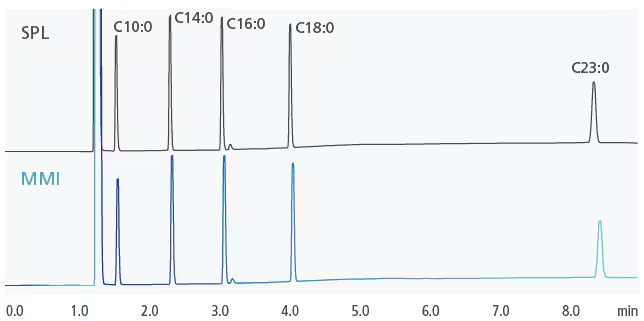
Click drawing to inspect vector dimensions