
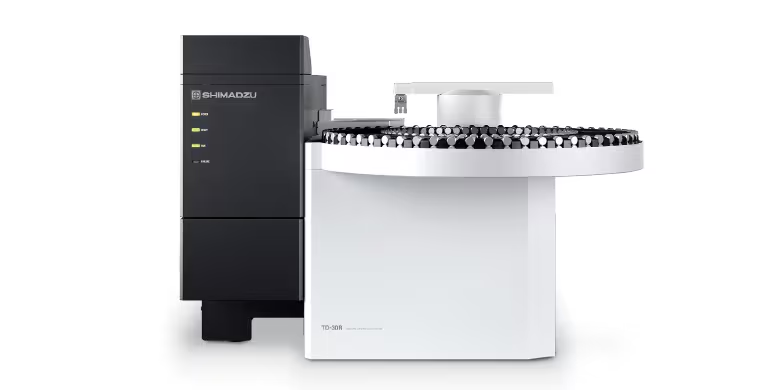
Shimadzu TD 30 Series
Shimadzu TD 30 Series — Mass spectrometers.
The TD 30 Series is a thermal desorption autosampler system for GC-MS, available in TD-30 (60-tube) and TD-30R (120-tube) configurations. It desorbs tubes from room temperature +15 °C to 430 °C with ±1 °C accuracy and focuses analytes via a Peltier-cooled cold trap. The system integrates with the GCMS-TQ8040 RX and GCMSsolution software for automated volatile and semi-volatile analysis.
Direct drop-in replacements
Full specifications
| Carrier gas | Nitrogen and Hydrogen |
| Sample capacity (TD-30R) mfr | 120 tubes (TD-30R) |
| System configuration (TD-30R) mfr | GCMS-QP2050 + Nexis GC-2060 + TD-30R (TD-30R) |
| Barcode reader mfr | Optional |
Description
Construction and positioning
The TD 30 Series is a front-end thermal desorption autosampler for GC-MS, offered in two tube-capacity variants: TD-30 (60 tubes) and TD-30R (120 tubes). Both share the same desorption and trap architecture; the choice between them is purely a matter of sample throughput and unattended run time. The system is configured as part of a Shimadzu workflow with the GCMS-TQ8040 RX triple quadrupole mass spectrometer and GCMSsolution control software. ### Desorption and trapping behavior
Tube desorption occurs from room temperature +15 °C up to 430 °C with ±1 °C setpoint accuracy, allowing controlled release of analytes across a wide volatility range. Released compounds are focused on a cold trap cooled by a Peltier element, which cryogen-free operation simplifies laboratory infrastructure compared with liquid-nitrogen traps. The trap concentrates the desorbed band before transfer to the GC column, improving peak shape and sensitivity for trace components. ### Integration and operation
Because the TD 30 is an autosampler front end, its operation is sequenced with the GC-MS method: tube desorption, trap focusing, and transfer to the column are coordinated through the system controller and GCMSsolution. The Peltier trap requires adequate ventilation and heat rejection at the instrument location. Daily operation centers on loading tubes into the carousel, verifying desorption and trap temperatures in the method, and confirming that the transfer line and column interface are leak-tight.
Integration & Operating Notes
The thermal desorption autosampler must sit close enough to the GC inlet that the transfer line can be routed without sharp bends or excessive length; long or kinked transfer lines risk cold spots and analyte loss. Confirm bench space and clearance for the selected 60- or 120-tube carousel before installation.
The cold trap is cooled by a Peltier element rather than liquid cryogen. Its focusing performance depends on adequate heat rejection, so the instrument location must provide stable ambient temperature and unobstructed airflow around the trap housing; poor ventilation can degrade trap cooling and peak shape.
Tube desorption, trap cooling and transfer to the GC column are coordinated by the system controller under GCMSsolution. The method must define desorption temperature, trap timing and transfer conditions so that the GC run starts only after the trap has focused the desorbed band; manual override of this sequence can cause broad peaks or carryover.
Cold trap liners, transfer line ferrules and tube seals are wear items not included in the base delivery. Establish a replacement interval based on sample load and observed peak shape or carryover; the 120-tube TD-30R variant runs longer unattended and may require more frequent trap inspection.
Selection & Integration Q&A
Choose the TD-30 (60 tubes) for lower-throughput labs or short batches; choose the TD-30R (120 tubes) when unattended overnight or high-volume sequences are needed. Both share the same desorption and Peltier cold-trap architecture, so analytical performance is equivalent.
The documented configuration pairs the TD-30/30R with the Shimadzu GCMS-TQ8040 RX triple quadrupole mass spectrometer and GCMSsolution software, which coordinates tube desorption, trap focusing and the GC run sequence.
Sample tubes, cold trap liners, transfer line ferrules and tube seals are consumables not part of the base instrument. Plan spare trap liners and seals according to sample load; the TD-30R with 120-tube capacity may need more frequent trap inspection.