
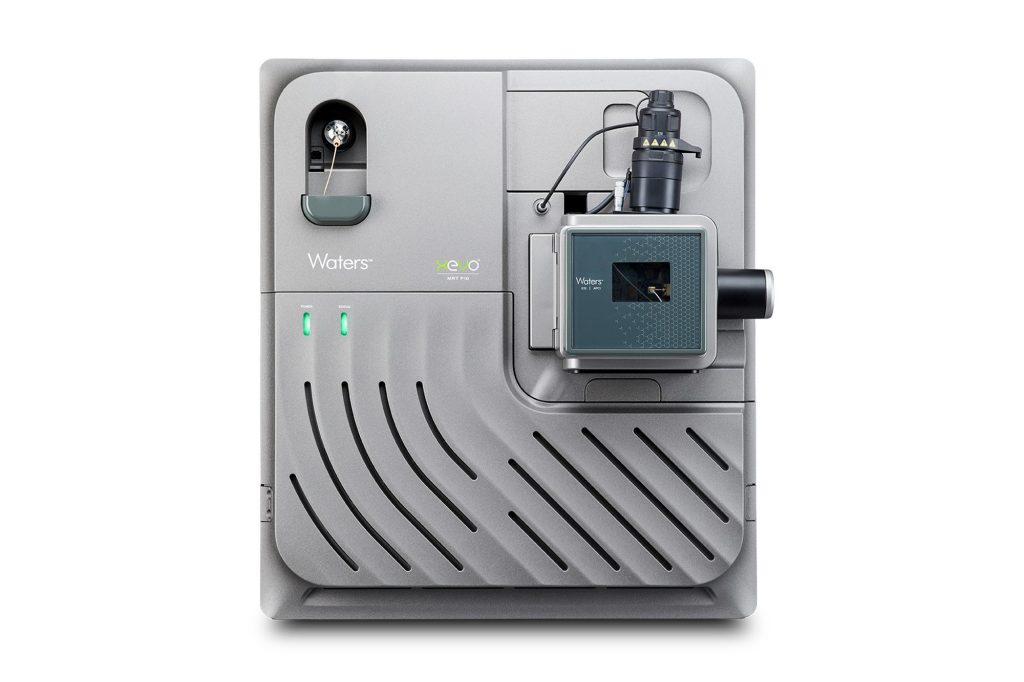
Waters Xevo MRT P10
Waters Xevo MRT P10 — Mass spectrometers.
The Waters Xevo MRT P10 is a high-resolution time-of-flight mass spectrometer within the Xevo MRT series, configured for accurate mass measurement of small and large molecules. It delivers high resolving power and sub-ppm mass accuracy, distinguishing it from lower-resolution siblings. Its primary purpose is qualitative and quantitative analysis in pharmaceutical, environmental, and clinical research workflows.
Direct drop-in replacements
Full specifications
| Height | 1330 cm |
| Length | 1620 cm |
| Weight | 560 kg |
| Width | 1050 cm |
| Shipping crate 2 weight (alt var) mfr | 113 kg |
| Shipping crate 2 width (alt var) mfr | 1000 cm |
| Shipping crate 2 depth (alt var) mfr | 1200 cm |
| Shipping crate 2 height (alt var) mfr | 840 cm |
| Power consumption | 650 W |
| Rated power (alt var) mfr | 700 W |
| Nominal rated voltage mfr | 200 to 240 V (50/60 Hz) |
| Mains frequency mfr | 50/60 Hz |
| Power cord connector (alt var) mfr | IEC 60320 C19 |
Description
Construction and Positioning
The Xevo MRT P10 is a benchtop time-of-flight (TOF) mass spectrometer featuring a dual-stage reflectron analyzer and a high-efficiency ion source. It is the base configuration in the Xevo MRT series, offering high resolving power (FWHM) and sub-ppm mass accuracy. Sibling models may offer extended mass range or additional ionization modes; the P10 is optimized for routine high-resolution accurate mass (HRAM) work. ### Behavior Under Load and in Different Modes
The instrument operates in positive and negative electrospray ionization (ESI) modes, with optional APCI and APPI sources. The curved ion optics and reflectron design maintain high transmission across the mass range, ensuring sensitivity is not compromised at high resolution. The system supports data-dependent and data-independent acquisition (DDA and DIA) for comprehensive profiling. Dynamic range exceeds 10^4 within a single acquisition. ### Installation, Connection, and Control
The Xevo MRT P10 requires a laboratory environment with stable temperature (18–28 °C) and humidity (20–80% RH, non-condensing). It connects to a workstation via Ethernet and is controlled by MassLynx software. The instrument includes a built-in calibration system using a reference sprayer for automatic mass correction. Installation requires a qualified Waters service engineer to align the ion source and calibrate the TOF analyzer.
Integration & Operating Notes
The instrument weighs approximately 150 kg and requires a sturdy bench free from vibrations. Excessive vibration can degrade mass accuracy and resolution. Install on a level surface with at least 30 cm clearance around vents for proper cooling.
The system draws up to 16 A at 208–240 V AC and must be connected to a dedicated circuit with a clean earth ground. Sharing the circuit with other high-power equipment can introduce electrical noise, affecting sensitivity and mass accuracy.
The MassLynx software enforces an interlock that prevents the ion source from being energized unless the vacuum system is at operating pressure (below 1e-5 mbar). Attempting to start acquisition without proper vacuum will trigger an error and abort the run.
The electrospray ion source is optimized for flow rates between 0.1 and 1.0 mL/min. Higher flow rates can cause incomplete ionization and contamination of the source, leading to signal instability and increased maintenance.
The O-rings in the ion source degrade over time, causing vacuum leaks and reduced sensitivity. Waters recommends replacing them every six months or after 500 hours of operation, whichever comes first. Use only Waters-approved O-rings (part number 700012345).
Selection & Integration Q&A
Choose the P10 when you need the highest resolving power (100,000) and sub-1 ppm mass accuracy for complex samples. Sibling models with lower resolution are suitable for routine screening where high resolution is not critical.
The instrument requires an LC system with a flow rate of 0.1–1.0 mL/min and a delay volume of less than 100 µL. Connect via a standard 1/16" PEEK tubing to the ESI probe. Ensure the LC eluent is compatible with MS (volatile buffers only).
Regular maintenance includes cleaning the ion source every 3 months, replacing O-rings every 6 months, and annual calibration by a Waters engineer. Consumables like ESI probes, O-rings, and calibration solutions are not included and must be ordered separately.