
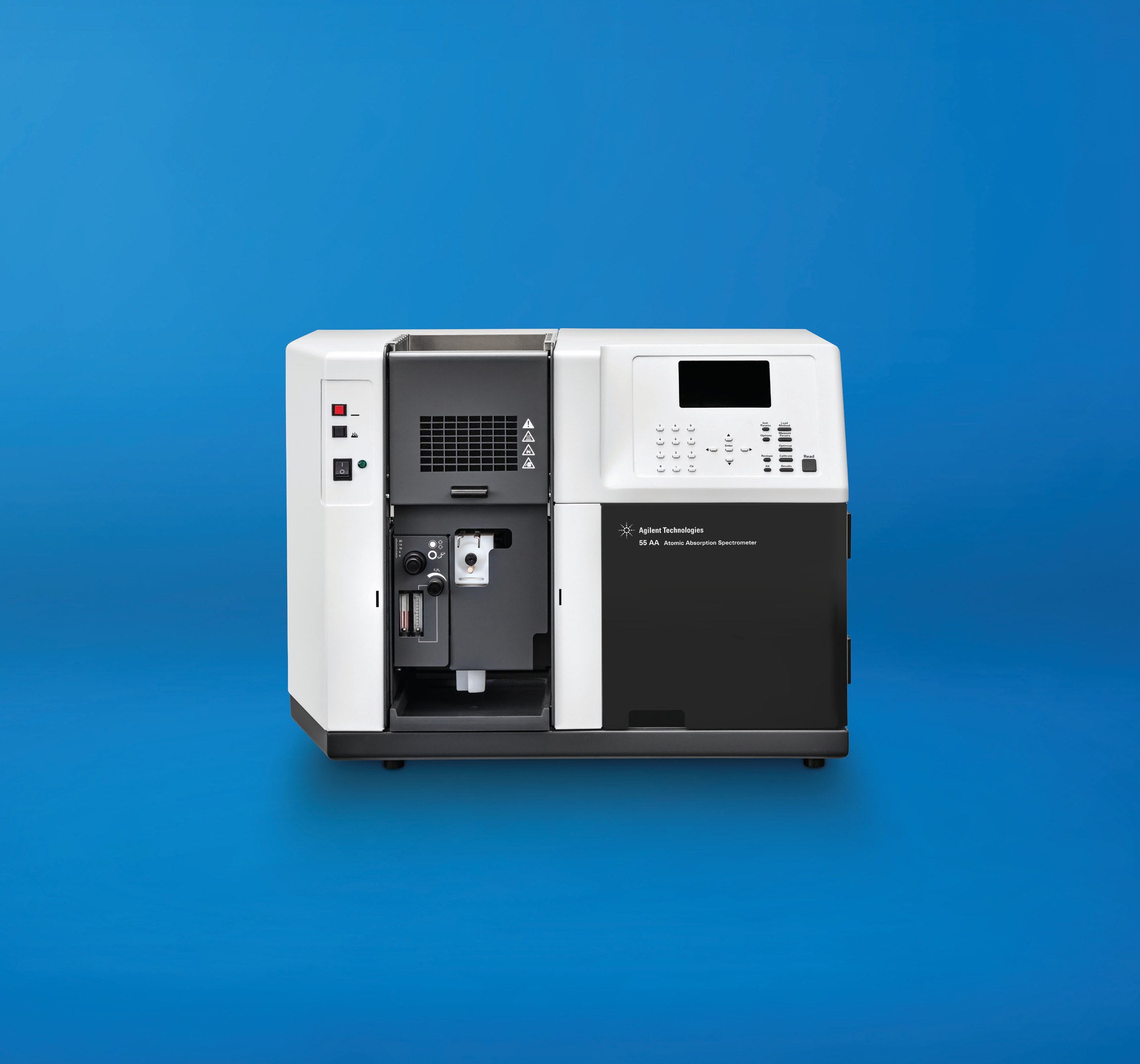
Agilent Technologies 55B AA
Agilent Technologies 55B AA — Atomic spectroscopy.
The Agilent 55B AA is a standalone double-beam flame atomic absorption spectrometer with a Mark 7 atomization system, LCD screen and dedicated keyboard, and two lamp positions. It is the basic AA configuration of the 55B series, distinguished from the 240FS AA and 280FS AA siblings by its manual gas box and absence of built-in SIPS. It serves routine flame AA determination of trace metals in liquid samples.
Agilent Technologies Flame Atomic Absorption Instruments Series — Model Comparison & Selection
Full specifications
| Sensitivity | 0.9 Abs |
| Precision | 0.5 % RSD |
| Viewing Distance From Flame (flame Door Open) | 0.8 m |
| Optical configuration mfr | double beam beam |
| Data connection mfr | -232 |
| Method storage mfr | 30 methods |
| Language options mfr | 8 languages |
| Lamp positions mfr | 2 |
| Exhaust ventilation rate mfr | 6 minute |
| Exhaust fan distance from flame mfr | 3 m |
| Acetylene bottle pressure mfr | 700 kPa |
| Working absorbance range mfr | 0.1...0.8 Abs. |
| Guaranteed absorbance mfr | 0.75 absorbance |
| Reslope signal tolerance mfr | 25 |
| Flame ignition timeout mfr | 7 s |
| Wait after failed ignition mfr | 5 seconds |
| Wide range PMT wavelength mfr | 900 nm |
| Signal saturation lower limit mfr | -0.3 Abs |
| Signal saturation upper limit mfr | 130 |
| Guaranteed absorbance (Mark 7 flame atomization) mfr | 0.75 Abs |
| Wait time after failed ignition mfr | 5 s |
| Stored methods mfr | 30 methods |
| Languages mfr | 8 languages |
| Wavelength and slit selection mfr | fully automated automated |
| Atomization system mfr | 7 |
| Impact bead adjustment mfr | externally adjustable adjustable |
| Background correction mfr | Deuterium background correction correction |
| Optics protection mfr | sealed optics with quartz overcoated mirrors; in |
| I mfr | Information Information |
| W mfr | Warning. Warning. |
| E mfr | Error Error |
| chimney distance from extraction hood mfr | 100 mm |
| minimum acetylene cylinder pressure mfr | 700 kPa |
| D2 lamp replacement interval mfr | 1000 hours |
| wide bore sampling capillary ID mfr | 0.64 ID |
| default lines per page mfr | 66 page |
| customized method slots mfr | 30 slots |
| dilution factor range mfr | 1.000 |
| Other wavelength range mfr | 180.0...900.0 nm |
| Blank mfr | 0.3 |
| Sample 001 mfr | 13.3 |
| Sample 001Dup mfr | 13.8 |
| Sample 013 mfr | 11.9 |
| Sample 014 mfr | 5.7 |
| Sample 013 Dup mfr | 11.5 |
| Sample 014 Dup mfr | 5.4 |
| Sample 017 mfr | 0.1 |
| Sample 023 mfr | 23.4 |
| Sample 024 mfr | 12.2 |
| Sample 025 mfr | 0.6 |
| Sample 026 mfr | 0.9 |
| Sample 023 Dup mfr | 23.9 |
| Sample 024 Dup mfr | 11.6 |
| background correction response time mfr | 2 ms |
| method storage capacity mfr | 30 methods |
| language options mfr | eight languages languages |
| air-acetylene burner slot length mfr | 10 cm |
| nitrous oxide-acetylene burner slot length mfr | 6 cm |
| nitrous-oxide/acetylene burner slot width limit mfr | 0.47 mm |
| air/acetylene burner slot width limit mfr | 0.54 mm |
| Mains frequency lower limit mfr | 48 Hz |
| Mains frequency upper limit mfr | 62 Hz |
| Control interface mfr | LCD screen and dedicated keyboard keyboard |
| Error message display duration mfr | five seconds seconds |
| Display mfr | industrial LCD screen with dedicated keypad keyp |
| Interface mfr | -232 |
| default baud rate mfr | 9600 |
| liquid trap specific gravity limit mfr | 0.75 |
| Ambient temperature limit | 20 °C |
| Working absorbance range (SIPS high standard) mfr | 0.1...0.8 Abs |
| STANDARD 1 mfr | 25.0 |
| STANDARD 2 mfr | 50.0 |
| STANDARD 3 mfr | 75.0 |
| STANDARD 4 mfr | 100.0 |
Description
Construction and series positioning
- Double-beam optical configuration with two lamp positions and a Wide Range PMT covering wavelengths up to 900 nm; a Short Range PMT variant also exists and must be matched to method wavelengths.
- Standalone operation via LCD screen and dedicated keyboard; 30 methods and 8 language options are stored on board. RS-232 provides the LIMS/data connection.
- Within the Flame Atomic Absorption Instruments series, the 55B AA is the basic instrument: the 240FS AA and 280FS AA are separate siblings, and SIPS accessories are covered in their own manuals rather than integrated here.
Behavior under load and in different media
- Quantitative performance is specified as 0.9 Abs sensitivity and 0.5 % RSD precision; Agilent guarantees absorbance of 0.75 or better with the Mark 7 flame atomization system under fully optimized conditions.
- Keep high standards within the working absorbance range of 0.1 to 0.8 Abs to avoid excessive calibration curvature. All calibrations use the New Rational algorithm, a quadratic least-squares fit A/C = a + b*A + c*A².
- Flame type dictates burner hardware: an air-acetylene burner is incompatible with an N2O-acetylene flame request and must be exchanged for an N2O-acetylene burner.
Installation, connection and control
- The instrument must be vented outdoors through a collector hood, ducting and exhaust fan rated at least 6 m³/min (200 scfm), with the fan at least 3 m from the flame and a back-draft damper fitted; the fan must run before the flame is lit.
- Fuel gas uses left-hand thread fittings and support gas right-hand thread fittings. Acetylene bottle pressure must exceed 700 kPa for stable flame signals.
- The liquid trap must be filled with the same solution as the sample matrix, and the drain tube must slope downward to the drain vessel without its end submerged. A vent tube is required on the upper vent nipple for organic or toxic liquids.
- Mains frequency must lie between 48 and 62 Hz. Error messages appear on the bottom display line for five seconds as a severity code (I, W, E), a four-digit number and a short message.
Integration & Operating Notes
Hot combustion gases will damage or melt fan components if the fan is closer than 3 m to the flame. Place the fan as close to the outdoor outlet as possible, fit a back-draft damper, and confirm the system delivers at least 6 m³/min (200 scfm) before first ignition.
Standards above this absorbance range produce excessive curvature in the quadratic New Rational fit, degrading the calibration. Choose standard concentrations and any dilution so that measured absorbance stays inside 0.1 to 0.8 Abs, and verify flame atomization against the guaranteed 0.75 Abs benchmark.
Requesting an N2O-acetylene flame with the air-acetylene burner fitted raises error 9912 and blocks operation. Change to the N2O-acetylene burner whenever the method calls for that flame, and confirm the burner is seated before starting the ignition sequence.
The liquid trap must contain the same solution as the standards and samples to keep spray-chamber pressure consistent and reduce flashback risk. Route the drain tube downward to the drain vessel without submerging its end, and attach a vent tube to the upper vent nipple when running organic or toxic liquids.
Errors 9307 and 9309 flag low and high mains frequency respectively; on double-beam instruments the reference beam chopper is also implicated. Check laboratory supply quality before commissioning, since out-of-range frequency interrupts normal measurement.
Error messages remain on the bottom display line for only five seconds, shown as a severity letter (I, W, E), a four-digit number and a short message. Capture the complete code immediately; persistent 9xxx GPIB, Instrument or SpectrAA errors require restart and contact with Agilent trained personnel.
Error 9528 (background lamp failed) is cleared by replacing the D2 lamp as described in Chapter 6; error 9529 (background lamp interlock) requires removing and re-installing the D2 lamp bracket. Plan lamp spares and bracket access before scheduling background-corrected methods.
If ignition does not occur within 7 seconds, wait at least 5 seconds for residual gases to disperse before retrying. Repeated timeouts point to low acetylene supply, incorrect fuel flow at the MANUAL gas box, or a faulty igniter; check these before further attempts.
Selection & Integration Q&A
Pick the 55B AA for basic standalone double-beam flame AA with a manual gas box, LCD/keyboard control, 30 stored methods and RS-232 LIMS output. The 240FS AA and 280FS AA are separate series members; SIPS accessories are documented separately and are not integrated into this basic instrument.
An exhaust system rated at least 6 m³/min (200 scfm) with the fan at least 3 m from the flame and a back-draft damper. Fuel lines use left-hand thread fittings, support gas lines right-hand thread. Acetylene bottle pressure must exceed 700 kPa, and compressor air must be moisture-free before the gas control module.
Store cylinders vertically, secured, ventilated and cool: pressure relief devices release contents above 52 °C (125 °F). The exhaust fan must run before every ignition, the liquid trap must be filled with the sample matrix solution, and the drain tube must slope downward without its end submerged.
SIPS accessories and the VGA 77 vapor generation accessory are covered in their own manuals and are not part of the basic instrument. D2 lamp replacement and bracket re-installation (errors 9528/9529) are user service actions per Chapter 6; N2O-acetylene burners are separate hardware from the air-acetylene burner.