
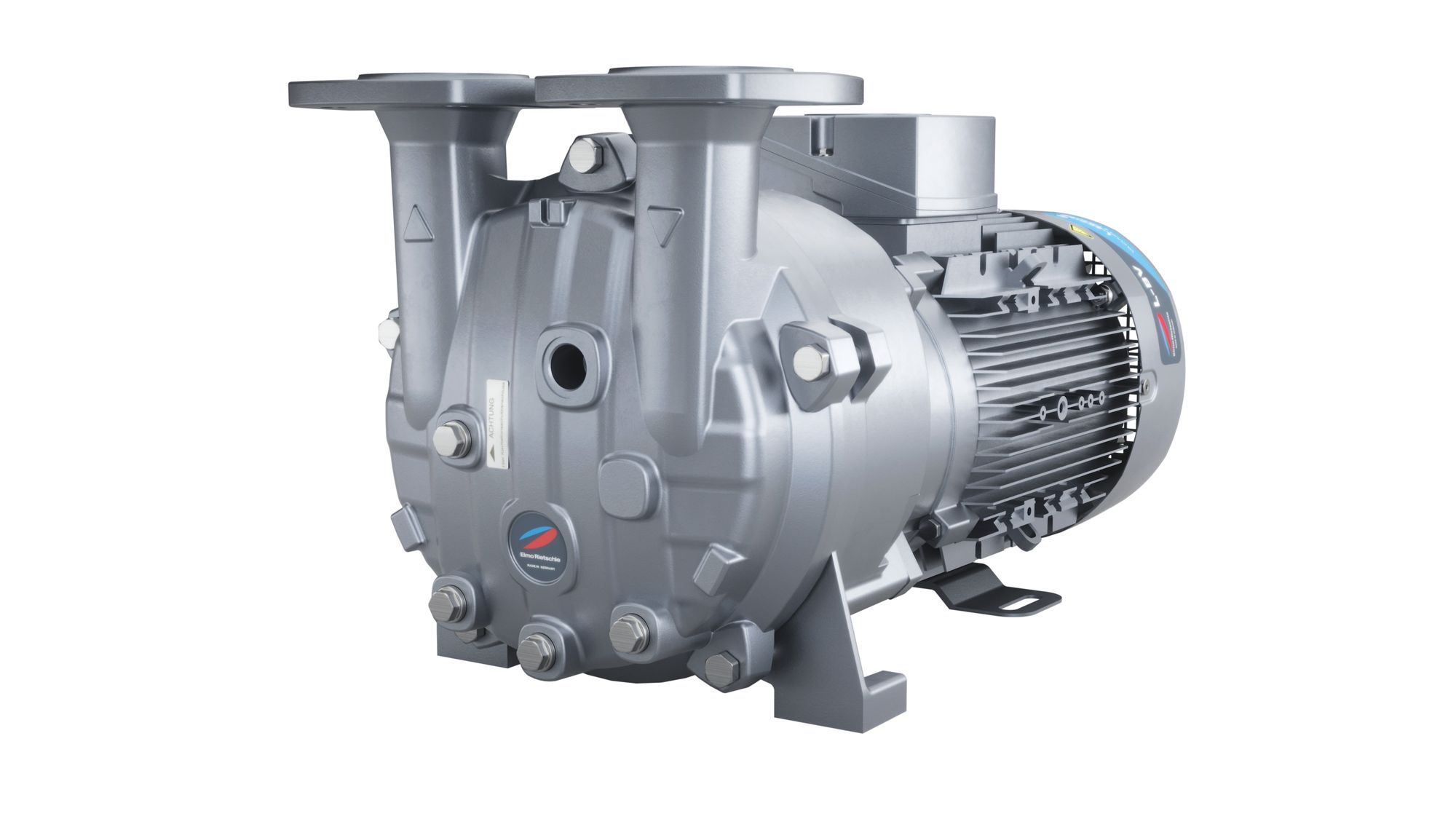
Elmo Rietschle L-BV5 2060
Elmo Rietschle L-BV5 2060 — Liquid Ring Vacuum Pumps.
The L-BV5 2060 is an ATEX-certified liquid ring vacuum pump (internal 2G, T4) from the L-BV5 series, built for occasional explosive gas/vapour atmospheres. It operates with an operating liquid between +5 °C and +65 °C (nominal +15 °C) and requires suction pressure at least 50 mbar above the vapour pressure. Its primary purpose is safe, reliable vacuum generation in process systems where direct VFD operation is prohibited and independent monitoring of liquid feed and level is mandatory.
Elmo Rietschle L-BV5 Series — Model Comparison & Selection
Full specifications
| Operating temperature | +65 °C |
Description
Construction and series positioning
- The L-BV5 2060 is a liquid ring vacuum pump in the L-BV5 series, supplied in ATEX construction (marking II 2G Ex h IIC T3 Gb with option F91).
- Unlike sibling models 2BV5110, 2BV5111, 2BV5121 and 2BV5131, which are listed with motor powers from 5.5 kW to 15.0 kW and some as ring blow or liquid ring compressors, the L-BV5 2060 is specified for vacuum duty with a smaller frame (liquid level window 75–95 mm).
- The higher corrosion-resistance/hygiene construction is not available for this type; it is restricted to 2BV2070 and 2BV2071 variants.
Behaviour under load and media
- The operating liquid temperature must stay between +5 °C and +65 °C, with +15 °C as the nominal design point. Exceeding +65 °C risks seal damage and invalidates ATEX compliance.
- Suction pressure must remain at least 50 mbar above the vapour pressure of the operating fluid; otherwise cavitation occurs and the manufacturer must be consulted.
- The operating liquid must have an ignition temperature above 150 °C and, if non-water, a heat capacity of at least 3 kJ/kg K and a boiling point at least 20 K above the input temperature.
Installation, connection and control
- The unit requires pressure monitoring on the discharge side (G2) that switches off the pump if p2 max is exceeded.
- Compulsory independent monitoring of operating liquid feed (trip at ≤50 % of design flow) and liquid level (start-up only within hf min/hf max) is required; these systems must function independently, even when a computer-programmed control is used.
- Electrical connection must follow the motor manual; operation with a frequency converter is explicitly not permitted.
- Bleeder resistance to ground must be < 10^6 Ohm for the unit and each attached accessory.
Integration & Operating Notes
If the suction pressure falls to within 50 mbar of the operating fluid's vapour pressure, cavitation and loss of ring integrity occur. The manufacturer must be consulted before operating outside this margin, and any change of media or temperature requires re-evaluation.
The flow monitor must trip at ≤50 % of design operating fluid flow, and the level monitor must only permit start-up when the level is between 75 mm and 95 mm. These two monitoring paths must be fully independent, even when implemented in a computer-programmed control, to avoid a common-cause failure.
The motor must be connected directly to the supply. Using a VFD is a forbidden misuse under the ATEX approval and can lead to unacceptable temperature rises or ignition hazards. Ensure the motor protection and cabling follow the separate drive motor manual.
Each installed accessory and the pump itself must have a bleeder resistance below 10^6 Ohm to ground. This must be measured after final assembly, as electrostatic charging from isolated metal parts can create an ignition risk in the ATEX zone.
The cooling/feed system must maintain the operating liquid within this range, with +15 °C as the nominal design point. Exceeding +65 °C risks seal damage and invalidates ATEX compliance.
Remove dust from the unit weekly. Ball bearings must be re-greased or replaced by a service technician every 2 years or 18,000 operating hours. The operator may not carry out any maintenance requiring dismantling of the machine.
If a suction-side separator is required, it must be a pressure-resistant construction per 2014/68/EU; the standard catalogue 2BX separator must not be used. This ensures the separator can withstand the vacuum and potential pressure surges without failure.
Selection & Integration Q&A
Choose the L-BV5 2060 for lower flow vacuum duty in ATEX zone 2G with a compact liquid level window (75–95 mm). Larger siblings 2BV5121 (11 kW, 40 m³/h) and 2BV5131 (15 kW) suit higher capacity but have different level windows and may not be available in the same ATEX variant. The 2060 is not available in the corrosion-resistant construction; for aggressive media, select 2BV2070 or 2BV2071.
Install pressure monitor G2 downstream of the gas output flange; it must switch off the unit if p2 max is exceeded. The operating liquid feed monitor must trip at ≤50 % of design flow, and the liquid level monitor must only allow start-up between 75 mm and 95 mm. Both monitoring systems must be independent and function even under computer control.
The unit is approved for ATEX category 2G (internal T4, surrounding T3) and may only be installed where explosive gas/vapour atmospheres occur occasionally; zone 0 is forbidden. Bleeder resistance to ground must be < 10^6 Ohm for the unit and each attached accessory. Ambient temperature must respect the T3 limit, and the operating liquid must stay within +5 to +65 °C.
Weekly dust removal and ball bearing service every 2 years or 18,000 operating hours by a service technician are mandatory. The base delivery does not include monitoring sensors (flow, level, temperature, pressure), pressure-resistant suction-side separator, or the 2BX series operating fluid separator; these must be ordered separately. Note that independent monitoring of operating liquid feed and level is compulsory for safe operation, so the required sensors must be supplied and installed even though they are not part of the base delivery. The standard catalogue separator is not permitted for suction-side use.