
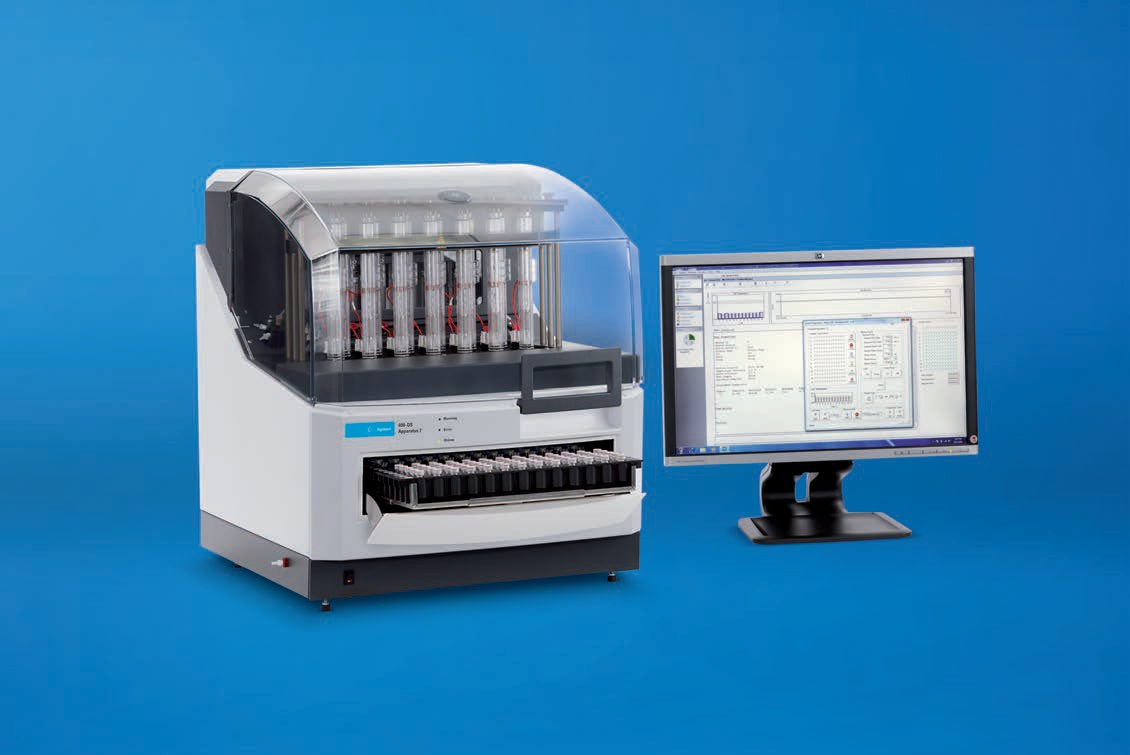
Agilent Technologies 400-DS Apparatus 7
Agilent Technologies 400-DS Apparatus 7 — Dissolution testing.
The 400-DS Apparatus 7 (G7975A) is a compendial small-volume dissolution apparatus integrating an autosampler, multiport valve, magnetically coupled agitators and a 5 mL or 10 mL dissolution cell. It handles up to 13 samples and 5 media per test, with 20 mm reciprocation and 1–35 DPM dip rate. It is used for USP Apparatus 7 testing of drug-eluting stents and extended-release medical devices.
Agilent Technologies Dissolution Apparatus Series — Model Comparison & Selection
| Model | Temperature, °C | Coverslip type | Weight, kg | Operating altitude, m | Pumping speed, m³/h | Operating temperature, °C |
|---|---|---|---|---|---|---|
| 400-DS Apparatus 7 Current | Delayed Start | Use the drop-down arrows | 59 | 2000 | — | 55 |
| 708-DS Dissolution Apparatus | 37 | 0.1 | 54.4 | 2000 | 3×10⁻⁵ | — |
Full specifications
| Temperature | Delayed Start |
| Communication | 1.7 |
| Coverslip type | Use the drop-down arrows to indicate Media A, Media B, Media C, Media D, Media E, or Rinse media. |
| Dissolution cell volume mfr | 5 mL |
| Maximum simultaneous samples mfr | 12 samples |
| Number of independently controlled systems per PC mfr | 4 systems |
| Safety standards mfr | IEC, EN, CSA, UL UL |
| Sample reciprocation mfr | 20 mm |
| Dip rate mfr | 1 DPM |
| Sample timepoints mfr | Specified as HHH:MM:SS SS |
| Samples per test mfr | 13 |
| Evaporation mfr | 0.2 hours |
| Maintenance and safety-related features mfr | Function to prevent overheating overheating |
| GLP features mfr | User management and run log with the software so |
| Housing mfr | All materials are recyclable recyclable |
| Number of samples tested simultaneously mfr | 12 samples |
| Number of 400-DS systems controllable from one PC mfr | 4 systems |
| Dissolution cell volume options mfr | 5 mL |
| Number of autosampler racks mfr | 13 racks |
| HPLC sampling vial sizes mfr | 2 mL |
| Maximum time points mfr | 36 points |
| Maximum independently controlled systems per PC mfr | four dissolution apparatus apparatus |
| Section Parameter mfr | Description Description |
| System Name mfr | Enter a name for your system. system. |
| Laboratory mfr | Enter a laboratory name. name. |
| System Configuration mfr | 29. |
| Run Method mfr | 66. |
| Test Reports mfr | 70. |
| Status mfr | Click one of the pie-shaped graphics under statu |
| Restrict Execution To Specified Server mfr | Serial Number Number |
| Volume Calibration Coefficient mfr | Slope Slope |
| Product Name mfr | Enter the name of the product. product. |
| Notes mfr | Enter any relevant notes regarding the sample. s |
| Profile Interval mfr | Enter the timepoint in hh:mm format at which the |
| Sampled Volume (mL) mfr | Use the up and down arrows to indicate appropria |
| Dissolution Volume (mL) mfr | Use the up and down arrows to indicate appropria |
| Cell Temperature mfr | Enter the desired tube temperature in degrees Ce |
| Hold Time (mm:ss) mfr | Enter the desired duration for the sample holder |
| Dip Speed (DPM) mfr | 400 DS. |
| Dip Interval (hhh:mm:ss) mfr | Enter the desired duration for dipping in hhh:mm |
| Syringe Properties mfr | Aspirate Flow Rate Rate |
| Auto Clean After Method Completion mfr | Auto Clean Cycles Cycles |
| Sample Information mfr | Product Name Name |
| Injection Control mfr | Enable Injections Injections |
| Timepoints mfr | 36 |
| Sample rows mfr | 12 |
| Methanol concentration mfr | 100 |
| Ethanol concentration mfr | 100 |
| Volume deviation mfr | 1.5 |
| Weight | 59.0 kg |
| Dimensions (height × width × depth) mfr | 533.4 mm |
| Line voltage mfr | 115 |
| Line frequency mfr | 60 Hz |
| ISM Classification mfr | 1 A |
| Power consumption mfr | 8 A |
| Minimum media volume mfr | 3 mL |
| Number of media per method mfr | 5 media |
| Media volume mfr | 3 mL |
| Media types per test mfr | 5 |
| Number of media usable per method mfr | 5 media |
| Minimum media volume (5 mL cell) mfr | 3 mL |
| Maximum number of media per method mfr | five five |
| Media Description mfr | Media A A |
| Media types mfr | five five |
| Operating Altitude | 2000 m |
| Operating temperature | 55 °C |
| Humidity mfr | 80 % r.h. |
Description
Construction and positioning
- The 400-DS is a self-contained bench instrument (59.0 kg, 533.4 × 584.2 × 596.9 mm) with integrated autosampler, multiport valve, magnetically coupled agitators and dissolution cell.
- Within the Agilent dissolution series it is the small-volume reciprocating-cylinder (USP Apparatus 7) modification, distinct from the 708-DS (USP Apparatus 1/2) and the BIO-DIS reciprocating cylinder apparatus.
- Cell variants: 5 mL cell (3–5 mL media) or 10 mL cell (8–12 mL media); sample trays accept 1.5 mL or 4 mL pre-capped HPLC vials.
- Up to four 400-DS units can be fully programmed and run from a single PC.
Behavior under load and in different modes
- Sample reciprocation is fixed at 20 mm ± 1.0 mm; dip rate is programmable from 1 to 35 DPM at 5.0% of rate.
- Temperature control is ambient + 5 to 55 °C with accuracy ± 0.2 °C or better; set points must be at least 5 °C above ambient.
- Media volume accuracy is 1% of volume; evaporation is 0.2% or better of volume in 24 hours, requiring the evaporation cover control during long runs.
- Methods are limited to 13 sample timepoints and 5 media types per test; sample timepoints are specified as HHH:MM:SS.
- Media compatibility is restricted to aqueous media plus methanol and ethanol up to 100%; other organic solvents are not validated.
Installation, connection and control
- Power: 115/230 V~ ±10% at 60/50 Hz, 8 A, with no voltage selector and no externally accessible fuses (automatic electronic fuses); line fuses, if replaced, are T 10A H 250V (PN 2110-1004).
- For single-system setup the loop back switch is set left (ON); for multiple systems the first and intermediate units are set right (OFF) and the final unit left (ON).
- Control requires Dissolution Workstation software version 1.7 onwards with firmware 1.6; PCL6 or PPD printer drivers are needed for GLP report printing.
- Bench clearances: 10 cm on either side, approximately 20 cm at the rear, and a minimum of 40 cm above the unit.
- Ambient operating temperature 5–40 °C; humidity 80% r.h. up to 31 °C decreasing linearly to 50% r.h. at 40 °C, non-condensing; altitude up to 2000 m; indoor use only.
Integration & Operating Notes
Other organic solvents have not been tested or validated for use with the 400-DS. Method media selection must stay within aqueous media plus methanol and ethanol up to 100% concentration to remain within validated use.
Temperature control range is ambient + 5 to 55 °C with accuracy ± 0.2 °C or better. Setting a cell temperature closer than 5 °C above ambient is outside the specified control range and may not hold accuracy.
Allow 10 cm on either side, approximately 20 cm at the rear, and a minimum of 40 cm above the unit. These clearances are needed for air circulation and access to liquid and electric connections; insufficient space can affect thermal control and service access.
The Clean System cycle rinses media lines and sample cells and must be executed between each dissolution method with an appropriate cleaning solution to control carryover. Sample holders must be rinsed immediately after use with corrosive materials and dried completely with a soft lint-free towel.
Selection & Integration Q&A
Choose the 400-DS for USP Apparatus 7 small-volume testing of drug-eluting stents and medical devices, with 5 mL or 10 mL cells and media volumes from 3 mL. The 708-DS is a USP Apparatus 1/2 basket/paddle system for conventional dosage forms; the BIO-DIS is a reciprocating cylinder apparatus without the 400-DS small-volume cell and autosampler integration.
The 400-DS requires Dissolution Workstation software version 1.7 onwards with instrument firmware 1.6. One PC can run up to four 400-DS units simultaneously. PCL6 or PPD printer drivers must be installed for printing system configuration and audit trail reports.
Calibration is recommended every six months (extendable to a year per SOP). The Clean System cycle requires an appropriate cleaning solution between methods. Sample trays use 1.5 mL or 4 mL pre-capped HPLC vials, which are consumables not part of the base delivery. Line fuses T 10A H 250V (PN 2110-1004) are the specified replacement type.