
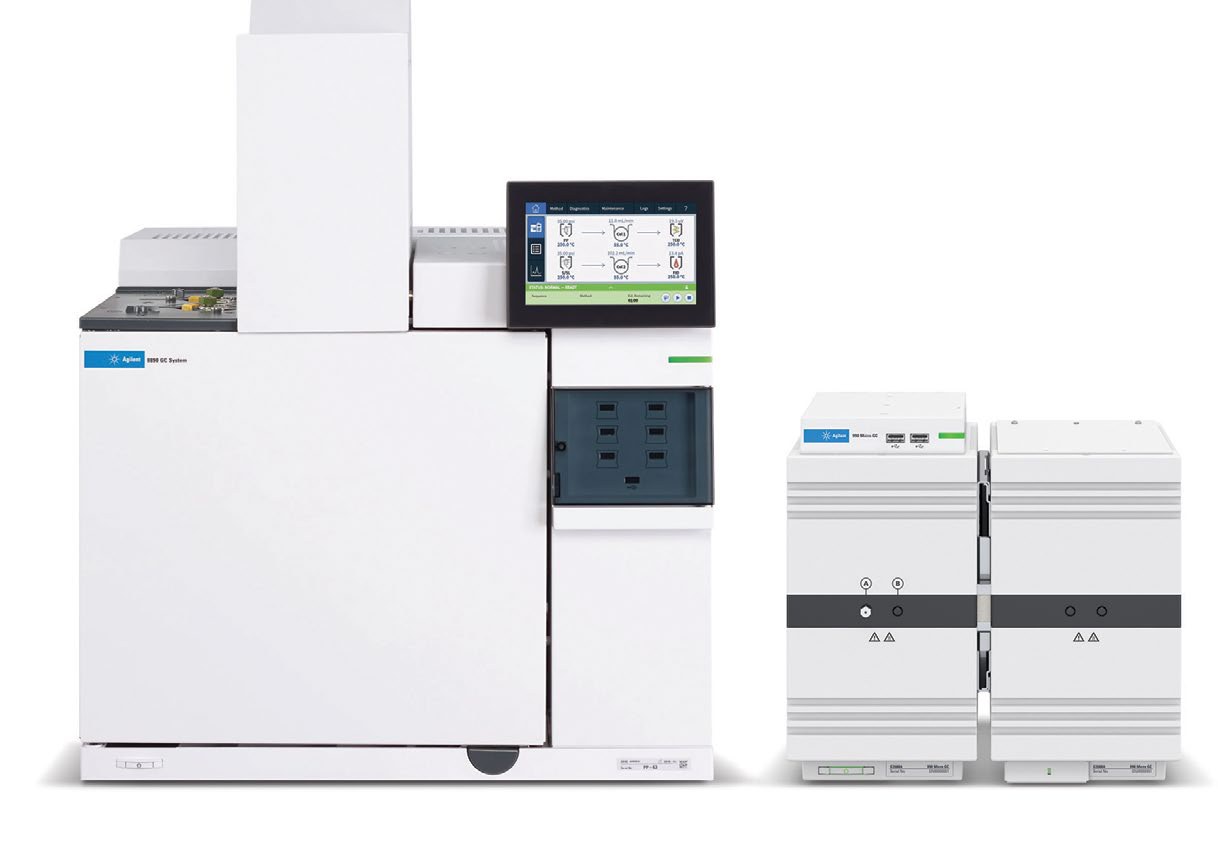
Agilent Technologies NGA Analyzer, natural gas analysis
Agilent Technologies NGA Analyzer, natural gas analysis — Gas chromatography.
The Agilent NGA Analyzer is a factory-configured, chemically tested three-channel gas chromatograph built on the 8890 GC or 990 Micro GC platform, dedicated to natural gas analysis per UOP 1945. It combines three valves, four columns, and TCD/FID detection to quantify H2, O2, N2, and extended hydrocarbons down to 0.01 mol% in a 20-minute cycle. This modification is the dedicated natural gas analyzer in the series, serving as the fixed-configuration natural gas composition monitor in energy and chemical process streams.
Agilent Technologies Energy Chemical GC Analyzers Series — Model Comparison & Selection
| Model | Typical quantitation limit, mol% | Carrier gas | Analysis time, min |
|---|---|---|---|
| NGA Analyzer, natural gas analysis Current | 0.01 | — | 20 |
| Analyzers for biodiesel, biofuels | 0.01 | — | — |
| Gasoline analyzer, benzene analysis | 0.01 | — | — |
| GCxGC-based analyzers, aviation turbine fuels | — | Hydrogen | — |
| natural gas analyzer, fast analysis times | 0.01 | — | 20 |
| Refinery gas analyzer, four channel multi-dimensional system | — | Argon | — |
Full specifications
| Analysis time | 20 minutes |
| Typical Quantitation Limit | 0.01 mol% |
| Valves mfr | 3 |
| Detectors mfr | TCD/FID TCD/FID |
| Columns mfr | 4 |
| Analyzer channels mfr | Three-channel channel |
| Configured per published method mfr | 1945 UOP |
| Analysis capacity for H2 mfr | Yes Yes |
| Analysis capacity for O2 and N2 mfr | Yes Yes |
| Extended hydrocarbon analysis mfr | Yes Yes |
Description
Construction and series positioning
- The NGA Analyzer is a factory-built, chemically tested GC system available on two platform bases: the Agilent 8890 GC (bench-top, full-featured) or the 990 Micro GC (compact, fast). The specific platform is selected at order time via option codes (#610–#615 for natural gas; #120–#123 for micro configurations).
- Within the Energy Chemical GC Analyzer series, this model is the dedicated natural gas analyzer. Sibling models cover biodiesel/biofuels, refinery gas (RGA), gasoline/benzene, and aviation turbine fuels via GCxGC. The NGA is distinguished by its three-channel architecture, three valves, four columns, and TCD/FID detector pair, configured to published method UOP 1945.
- The series also includes extended and sour-gas configurations; this card describes the base natural gas configuration unless a specific option is ordered.
Behavior and analytical range
- The system resolves H2, O2, N2, and an extended hydrocarbon range in a single 20-minute analysis. Typical quantitation limit is 0.01 mol% per component, making the analyzer suitable for custody-transfer-adjacent composition monitoring rather than trace-level impurity work.
- Three independent analyzer channels allow parallel separation of light fixed gases and hydrocarbons, with valve switching timed to the UOP 1945 method. The TCD handles permanent gases and the FID handles hydrocarbons; no single detector covers the full range alone.
- No digitized response curves are supplied in the verified facts; performance is defined by the method configuration and the factory chemical test, not by published chromatograms in this dataset.
Installation, control, and operation
- The analyzer is delivered as a factory-configured, chemically tested package. Site integration requires the platform-specific utilities (carrier gas, fuel gas for FID, air, and power) per the 8890 GC or 990 Micro GC site preparation guide; these are not itemized in the verified facts and must be taken from the platform manual.
- For the 990 Micro GC variant, an optional Agilent GC gasifier accessory (Part Number G3535A) is available for samples that require vaporization before the GC; this is an accessory, not part of the base analyzer delivery.
- Method compliance is tied to UOP 1945; any change to valve timing, column set, or detector configuration moves the system outside the factory-tested configuration and requires revalidation.
Integration & Operating Notes
The analyzer is factory-configured and chemically tested for natural gas per UOP 1945. Feeding sour gas, refinery gas, or fuel samples outside this configuration will not produce validated results; select the sour-gas or RGA sibling configuration instead. Sample pressure, temperature, and particulate conditioning must match the platform site-prep requirements.
The three valves and four columns are sequenced for the published UOP 1945 method. Any external start signal, stream-selection valve, or sample-injection trigger must align with this fixed timing; altering the sequence invalidates the factory chemical test and the 20-minute cycle claim. Integrators should treat the analyzer as a method-locked subsystem, not a freely programmable GC.
Columns, valves, detector consumables, carrier and fuel gases, and the optional GC gasifier (G3535A, for 990 Micro GC, 8860 GC, and 8890 GC) are separate items. Plan spares and the gasifier only if the sample requires vaporization; the base NGA package does not include them. Service intervals are governed by the platform manual, not by the NGA configuration sheet.
Selection & Integration Q&A
Pick the NGA when the stream is pipeline-quality natural gas and UOP 1945 compliance is required. Choose the RGA sibling for refinery gas with a wider component slate, and the sour-gas NGA variant when H2S or other sulfur species are present; the base NGA is not configured for sour service.
The NGA is a method-locked subsystem: the sample conditioning system must deliver gas at the platform's required pressure and cleanliness, and the carrier, FID fuel, and air supplies must meet 8890 GC or 990 Micro GC site-prep specs. A stream-selection valve or start trigger must follow the fixed UOP 1945 timing.
Columns, valves, detector consumables, carrier and fuel gases, and the optional GC gasifier (G3535A for 990 Micro GC, 8860 GC, 8890 GC) are not part of the base package. Service intervals follow the platform manual; the NGA factory chemical test does not extend to consumable replacement schedules.