
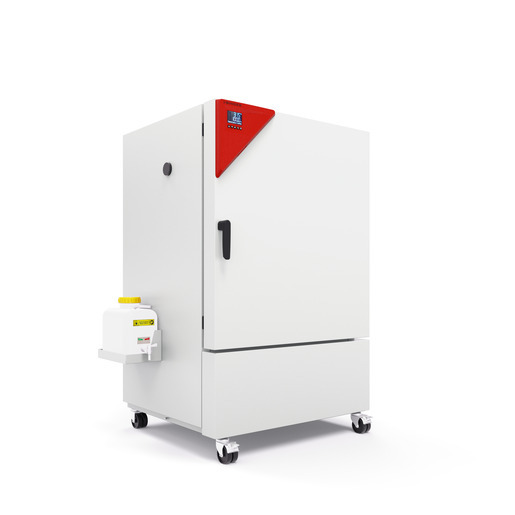
BINDER KBF-S ECO 240
BINDER KBF-S ECO 240 — Climate chambers with Temperature 0…70 °C.
The KBF-S ECO 240 is a 247-litre constant climate chamber using Peltier thermoelectric cooling and the RD4 microprocessor controller, with a 0–70 °C range and 10–80 % RH humidity control (5–70 °C with humidity active). It is the smallest of four KBF-S ECO sizes (240/400/720/1020) and is intended for long-term and accelerated stability testing under continuous duty.
BINDER KBF-S ECO Series — Model Comparison & Selection
| Model | Temperature, °C | Humidity fluctuation, % rh | Interior volume, L | Load per rack, kg | Max heat compensation, W | Nominal power, kW |
|---|---|---|---|---|---|---|
| KBF-S ECO 240 Current | 0–70 | 0.3 | 247 | 30 | 250 | 0.8 |
| KBF-S ECO 1020 | 0–70 | 0.4 | 1020 | 45 | 400 | 1.2 |
| KBF-S ECO 400 | 0–70 | 0.3 | 400 | 30 | 300 | 1.1 |
| KBF-S ECO 720 | 0–70 | 0.3 | 700 | 45 | 400 | 1.2 |
Full specifications
| Temperature | 0...70 °C |
| Interior volume | 247 L (KBF-S ECO 240, 50/60 Hz) |
| Load per rack | 30 kg |
| Maximum heat compensation | 250 W |
| Nominal power | 0.8 kW |
| Temperature fluctuation | 0.1 K |
| Temperature uniformity | 0.1 K |
| Article Number mfr | 9020 |
| Recovery time after door was opened for 30 s at 25°C and 60% RH mfr | 5 min |
| Recovery time after door was opened for 30 s at 40°C and 75% RH mfr | 11 min |
| Depth | 796 mm |
| Height | 1461 mm |
| Width | 932 mm |
| Power frequency | 50/60 Hz |
| Rated voltage | 200...230 V (KBFSECO240-230V) |
| Unit fuse | 16.0 A |
| Humidity fluctuation | 0.3 % RH |
| Humidity range | 10...80 % RH |
Description
Construction and positioning in the series
- Peltier (thermoelectric) cooling replaces a compressor circuit; the chamber is rated for continuous operation and for 'long term testing' and 'accelerated testing' duty.
- 247 L usable interior, net dimensions 932 × 1,461 × 796 mm (W×H×D); rack load 30 kg per rack.
- Within the KBF-S ECO family the 240 is the smallest volume; the 400, 720 and 1020 share the same 0–70 °C range but differ in size and in features such as anti-condensation protection, which the manual lists only for the 400/720/1020.
- Two electrical variants exist: KBFSECO240-230V (200–230 V / 50 Hz or 208–230 V / 60 Hz, 3.5 A, CEE 7/7 plug) and KBFSECO240UL-120V (100–120 V, 6.7 A, NEMA 5-20 plug). Both are 0.80 kW nominal.
Behaviour under load and in different media
- Temperature fluctuation and uniformity are both stated as 0.1 K; humidity fluctuation 0.3 % RH.
- Recovery after a 30 s door opening: 5 min at 25 °C / 60 % RH and 11 min at 40 °C / 75 % RH.
- Maximum heat compensation 250 W; excessive external heat load or operation outside the optimum temperature/humidity window (manual Figure 19) degrades or stops refrigerating performance.
- Ambient temperature above 25 °C reduces refrigerating performance, so the installation site must stay at or below that for full capability.
- The humidity sensor tolerates permanent exposure to defined substance concentrations (e.g. NH3 5500 ppm, acetone 3300 ppm, formaldehyde 2400 ppm); exceeding them damages the sensor. Sensor tolerance is ±2 % RH.
Control, safety and operation
- RD4 controller with menu-based set-point entry, tolerance-range alarms (adjustable delay), program start/stop, week programs, data recorder (DL1) and USB import/export.
- Ethernet interface with configurable IP, subnet, gateway and DNS; APT-COM 4 software networks up to 100 chambers.
- Temperature safety: DIN 12880 class 3.1 overtemperature safety controller plus a class 1 protective device that trips at nominal temperature +10 °C.
- Humidity system can be switched off in the controller; idle mode and a self-test function are available. Defrosting is a defined refrigerating-mode procedure.
Integration & Operating Notes
The 230 V variant accepts 200–230 V / 50 Hz or 208–230 V / 60 Hz at 3.5 A with a CEE 7/7 plug; the UL variant needs 100–120 V at 6.7 A with a NEMA 5-20 plug. Supplying the wrong voltage causes malfunction, and the higher current of the UL version must be reflected in the branch circuit and its 16 A unit fuse coordination.
Refrigerating performance falls when ambient temperature exceeds 25 °C / 77 °F, so a climate-controlled room is required for full capability. Wall spacers and the specified installation-site clearances from the manual must be observed, and the chamber must not become wet (IP 20).
Combinations outside the optimum range of the temperature-humidity diagram (Figure 19) and external heat loads beyond the 250 W maximum heat compensation cause low or no refrigerating performance. With humidity active the working range narrows to 5–70 °C; plan sample heat dissipation and set-points accordingly.
The humidity sensor has stated permanent-load thresholds (e.g. ammonia 5500 ppm, acetone 3300 ppm, formaldehyde 2400 ppm) and a ±2 % RH tolerance. Test articles releasing solvents or bases above these concentrations will degrade humidity measurement, so outgassing loads must be assessed before loading the chamber.
A safety controller set too low prevents heat-up and triggers alarms; it must be set and function-checked per chapter 10.2. The class 1 protective device trips at nominal temperature +10 °C, so both layers must be configured consistently with the intended test profile before a run starts.
Ethernet settings (IP address, subnet mask, gateway, DNS, chamber address) and the DL1 recorder storage rate are set through the controller menus; USB import/export uses a front-panel stick. APT-COM 4 can manage up to 100 networked chambers, so address planning belongs in the integration phase.
Regular maintenance is required at least once a year, and the steam humidifier at least annually with interval depending on water quality and steam output. Repeat electrical inspection per EN 50678/VDE 0701 and EN 50699/VDE 0702 is required before first start-up and after maintenance or repair; work by non-authorized personnel voids warranty.
Selection & Integration Q&A
Pick the 240 when 247 L and 30 kg per rack cover the sample load; all four share the 0–70 °C range. The larger 400/720/1020 add anti-condensation protection, which the manual does not list for the 240, so humid programs with heavy condensation risk favor a larger frame.
The KBFSECO240-230V takes 200–230 V / 50 Hz or 208–230 V / 60 Hz, 1 N~, 3.5 A, 0.80 kW, with a CEE 7/7 plug and a 16.0 A unit fuse. The UL variant instead needs 100–120 V at 6.7 A with a NEMA 5-20 plug; do not mix the two.
Install where ambient stays at or below 25 °C, since higher ambient reduces refrigerating performance. Respect wall spacers and site clearances, keep the unit dry (IP 20), and stay within the temperature-humidity diagram and the 250 W heat-compensation budget for continuous operation.
Budget annual chamber and steam-humidifier service plus electrical retest per EN 50678/EN 50699. APT-COM 4 software, the BINDER Pure Aqua water-treatment accessory and USB sticks for data export are options/accessories, not part of base delivery; water quality must suit the humidifier.