
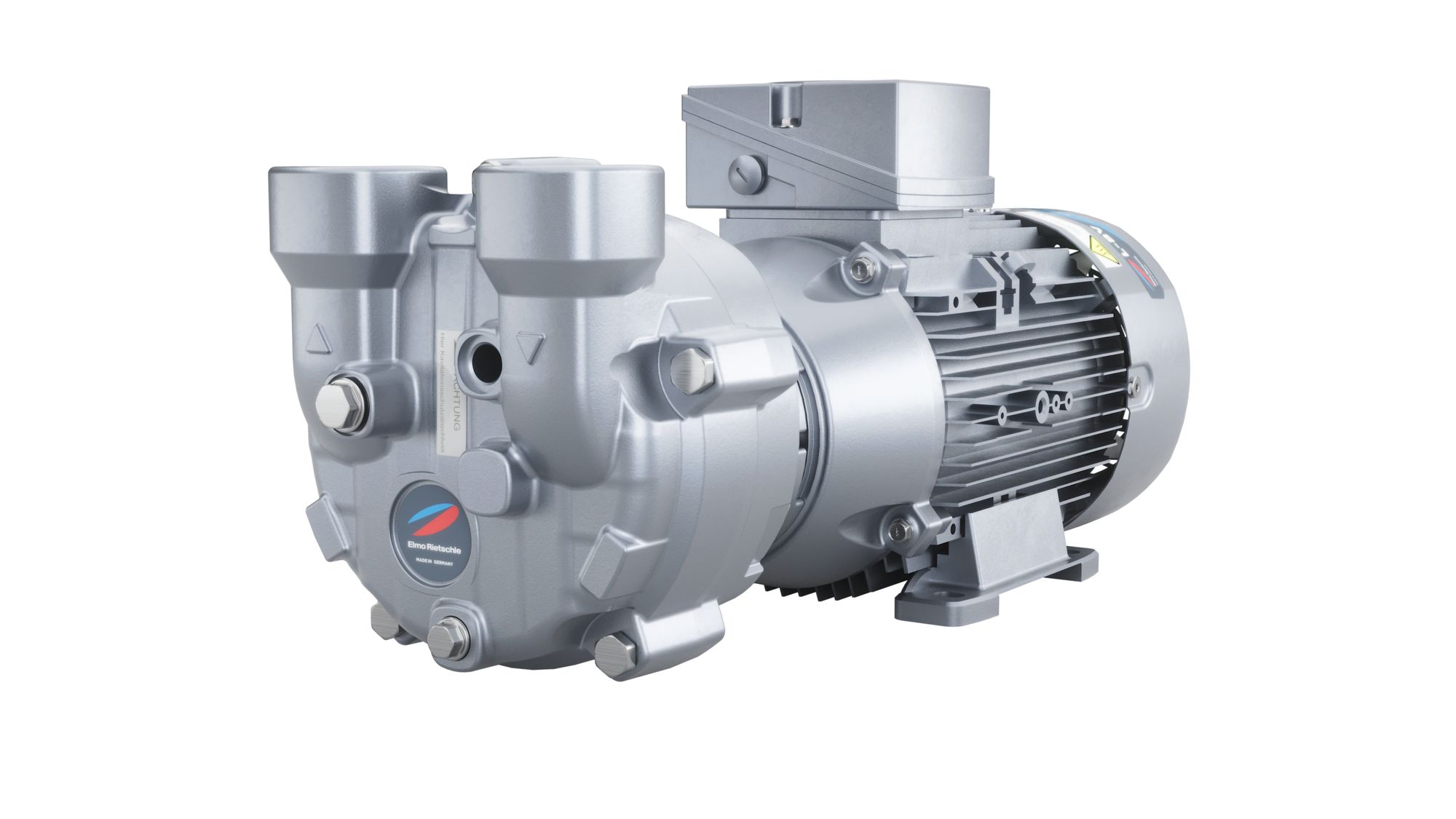
Elmo Rietschle 2BV2070
Elmo Rietschle 2BV2070 — Liquid Ring Vacuum Pumps with Max inlet pressure 101.3 kPa, Motor power 7.3 kW, Pumping speed 70 m³/h.
Single-stage liquid ring vacuum pump 2BV2070 with 7.3 kW AC motor, rated 70 m³/h at both 50 and 60 Hz and IP55 protection. It sits between the 3 kW 2BV2060/2061 and the 8.6 kW 2BV2071 in the L-BV2 series, and is one of the few types available in stainless-steel and higher-corrosion/hygiene construction. Used for continuous wet-vacuum duty where the operating liquid also absorbs heat and condensable vapours.
Elmo Rietschle L-BV2 Series — Model Comparison & Selection
Full specifications
| Max inlet pressure | 1013 mbar |
| Motor power | 7.3 kW |
| Operating principle | Liquid ring |
| Pumping speed | 70 m³/h (50 Hz) 60 Hz: 70 m³/h |
| Compression ratio | 1.00 dimensionless |
| Number of stages | 1 dimensionless |
| Weight | 49 kg |
| Power supply | AC |
| Noise level | 70 dB (50 Hz) 60 Hz: 70 dB |
| Operating temperature | 20 °C |
| Protection rating | IP55 |
Description
Construction and series position
- Single-stage liquid ring pump with a 7.3 kW AC motor; 49 kg; IP55; max inlet pressure 1013 mbar; compression ratio 1.00.
- Rated pumping speed is 70 m³/h at both 50 and 60 Hz, so the same casing covers both grid frequencies.
- Within the L-BV2 family the 2BV2070 is the mid-power frame: the 2BV2060/2061 deliver ~3 kW and 55 m³/h, while the 2BV2071 steps up to 8.6 kW. Choose the 2070 when 70 m³/h is sufficient and the 2071 would be oversized.
- Material variants N (cast iron casing with ceramic coating, bronze port plate), P (CrNi steel casing, ceramic port plate, CrNi impeller) and H (all CrNi steel) are listed for the 2BV2070; the higher corrosion-resistance/hygiene construction is available only for 2BV2070, 2BV2071 and 2BV5 series types. ATEX category 2G versions (II 2G Ex h IIC T3 Gb, option F91) also exist.
Behaviour under load and media limits
- The pump is a wet, liquid-ring machine: performance depends on a continuous operating-liquid feed. First fill is 1.0 L for the 2BV2070 frame; the design operating-liquid flow must be set on the flow limiter.
- Gas/vapour temperature may reach +80 °C; above that, increase operating-liquid flow to 2.5× design flow (2BV2 series) or install a pre-condenser, and guard against burns.
- Operating-liquid temperature +5 to +80 °C (nominal +15 °C); ambient +5 to +40 °C. Max discharge pressure in vacuum duty is 1.1 bar abs; max permissible internal pressure 8 bar abs.
- Water carry-over through the inlet is limited to 2.5× design flow continuous, 7× for max 2 s (2BV2 series); liquid separation upstream must keep within this.
- No digitized curve points were supplied, so no part-load curve is quoted here; use the design flow and pressure limits above.
Installation, connection and control
- Suction and discharge piping must not be tightened beyond 100 Nm. Fit an intake strainer in the suction line for the first 100 operating hours.
- Maintain heat-dissipation clearance of 53 mm around the fan guard for the 2BV2070 frame. Maximum installation altitude 1000 m; consult service above that.
- Electrical supply tolerance ±5 % voltage and ±2 % frequency. Motor insulation must be dried if resistance is ≤1 kΩ per volt of test potential. Terminal-box wiring must keep ≥5.5 mm air gap to non-insulated live parts and earth at UN ≤690 V.
- Frequency-converter operation is permitted on standard units only within the type-specific speed window 2123–3715 min⁻¹ for 2BV2070/2071; on ATEX versions a frequency converter is explicitly not permitted.
- Commissioning requires checking direction of rotation and avoiding dry running; pressure/leak testing and insulation-resistance checks are specified.
Integration & Operating Notes
The minimum achievable suction pressure is bounded by the vapour pressure of the operating liquid; the manual notes cavitation at the limit. In ATEX duty the suction pressure must stay at least 50 mbar above the vapour pressure, otherwise the manufacturer must be consulted. Set the process vacuum accordingly and monitor operating-liquid temperature, since it shifts vapour pressure.
With design operating-liquid flow maintained, discharge pressure in vacuum operation must stay at or below 1.1 bar abs for 2BV2 series types; the maximum permissible internal pressure is 8 bar abs. Discharge-side throttling or a blocked line can push past this, so provide pressure protection if the system can generate higher pressures.
The 2BV2070 frame needs 53 mm minimum clearance around the fan guard for heat dissipation; enclosing it or mounting tight to a wall risks overheating. Maximum installation altitude is 1000 m above sea level — consult the service department above that. Vibration velocity at the measuring points must stay below 4.5 mm/s.
Tightening torque for piping connections to the suction and discharge branches must not exceed 100 Nm. Over-tightening can damage the connections or the casing, particularly on the ceramic-coated and CrNi variants. Use appropriate seals and support the piping so the pump body does not carry line loads.
The motor is rated for ±5 % voltage variation and ±2 % frequency deviation without loss of performance. Before commissioning, check motor insulation resistance and dry the windings if it is ≤1 kΩ per volt of measurement potential. In the terminal box keep at least 5.5 mm air gap between non-insulated energized parts and to earth at UN ≤690 V.
Standard 2BV2070/2071 units may be run from a frequency converter only within 2123–3715 min⁻¹; exceeding this risks mechanical damage. On ATEX versions frequency-converter operation is explicitly not permitted, so the motor must be connected directly to the supply. Confirm the drive's maximum frequency maps inside the window before commissioning.
For ATEX duty, monitoring of operating-liquid feed, liquid level and discharge pressure must be fully functional and independent of one another, even under computer-programmed control. The flow monitor trips at ≤50 % of design flow, the temperature sensor at ≥60 °C, and the pressure switch downstream of the gas outlet must shut the unit off above p2 max. Liquid level must lie within the 95/120 mm window for the 2BV2070 before start-up.
Selection & Integration Q&A
Pick the 2BV2070 when you need about 70 m³/h at 50 or 60 Hz with a 7.3 kW motor. The 2BV2060/2061 give only ~3 kW and ~55 m³/h; the 2BV2071 jumps to 8.6 kW. The 2070 is also the smallest frame offered in the higher corrosion-resistance/hygiene construction.
Connect suction and discharge piping with tightening torque ≤100 Nm, fit an intake strainer for the first 100 operating hours, and ensure liquid separation keeps water carry-over within 2.5× design flow continuous (7× for max 2 s). Provide continuous operating-liquid feed with a flow limiter set to design flow, and first fill of 1.0 L.
Standard units may use a VFD only within 2123–3715 min⁻¹; ATEX versions forbid VFD operation entirely. Mount with 53 mm clearance around the fan guard, at altitudes up to 1000 m, ambient +5 to +40 °C, and keep vibration velocity below 4.5 mm/s.
Budget for bearing service every 2.5 years or 20,000 h (2 years/18,000 h on ATEX) with UNIREX N3 or DIN 51825-K3N grease, an intake strainer for the first 100 operating hours, and operating liquid at +5 to +80 °C. ATEX installations also need independent flow, level and discharge-pressure monitoring.