
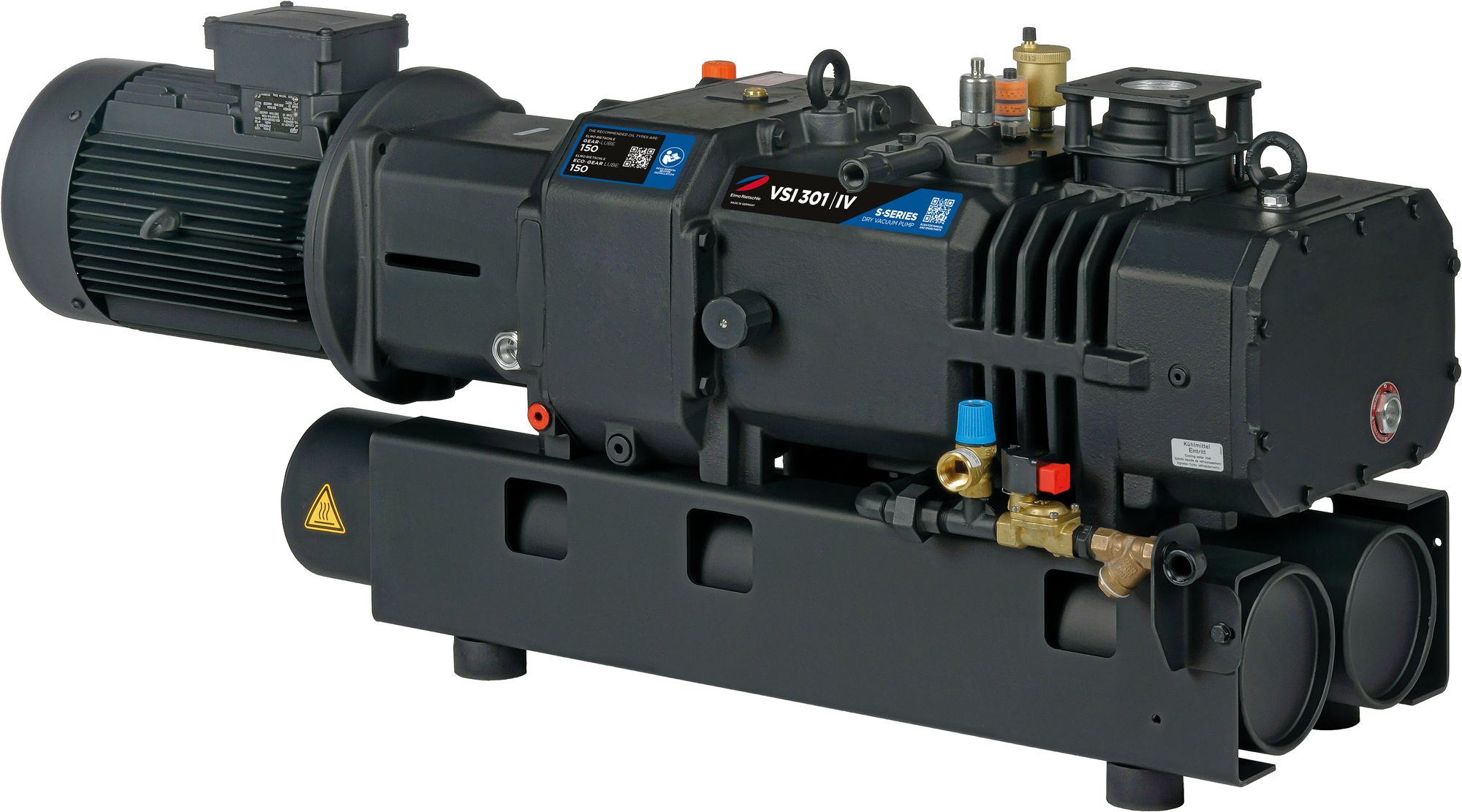
Elmo Rietschle VSI 300
Elmo Rietschle VSI 300 — Screw Vacuum Pumps with Motor power 9 kW, Pumping speed 380 m³/h, Ultimate pressure 0.1 mbar.
The VSI 300 is a two-shaft, oil-lubricated screw vacuum pump with a flanged three-phase motor and water cooling, rated 320 m³/h at 50 Hz and 0.1 mbar ultimate pressure. It is the mid-size unit of the VSI series, positioned between the VSI 100 and the higher-vacuum VSI 301, and is intended for continuous evacuation and humid-gas service in industrial vacuum systems.
Elmo Rietschle VSI Series — Model Comparison & Selection
Full specifications
| Lubrication type | oil-lubricated |
| Motor power | 5.5 kW (50 Hz) 60 Hz: 9.0 kW |
| Operating principle | screw |
| Pumping speed | 320 m³/h (50 Hz) 60 Hz: 380 m³/h |
| Ultimate pressure | 0.1 mbar |
| Rotational speed | 2900 rpm (50 Hz) 60 Hz: 3500 rpm |
| Height | 580 mm |
| Length | 1297 mm |
| Weight | 330 kg |
| Width | 454 mm |
| Max. weight (alt var) mfr | 335 kg |
| Power supply | 400/690 V ±10 % V (50 Hz) 60 Hz: 460 V ±10 % V |
| Motor rating (alt 50 Hz) mfr | 7.5 kW (50 Hz) |
| Inlet flange | G 2 |
| Oil capacity | 1.9 l |
| Noise level | 74 dB (50 Hz) 60 Hz: 76 dB |
| Operating temperature | 50 °C |
| Cooling type | water |
Description
Construction and series positioning
- Two parallel, non-contacting screw rotors are synchronised by an oil-lubricated gear pair; the compression chamber is separated from the gear chamber by special seals, and the gear chamber is vented to atmosphere and can be pressurised with sealing gas.
- Drive is taken from a standard flanged three-phase motor through an elastomer coupling; the motor is IP 55, insulation class F.
- Within the VSI series the 300 is the mid-size frame: the VSI 100 delivers 138 m³/h on a 3.0 kW motor, while the VSI 301 reaches 0.08 mbar ultimate pressure at 300 m³/h on a 9.0 kW motor. The VSI 300 offers 320 m³/h at 50 Hz (380 m³/h at 60 Hz) with 0.1 mbar ultimate pressure, using a 5.5 kW motor at 50 Hz and a 9.0 kW motor at 60 Hz.
- Standard cooling is through-flow water cooling of the double-walled compressor housing; optional control unit, thermostatic water valve and circulation cooling are described in the manual but are not part of the base machine.
Behaviour in service
- Free-suction capacity is 320 m³/h at 50 Hz (380 m³/h at 60 Hz), with ultimate pressure 0.1 mbar; continuous vacuum operation is specified over 0.1–1000 mbar (abs.).
- The pump is specifically suited to extremely humid gases and has high water-vapour tolerance; the gear-chamber sealing arrangement keeps the lubricant separate from the process gas.
- Outlet back pressure is limited to < +30 mbar on the 5.5 kW motor; exceeding this value risks damage or loss of performance.
- When evacuating a closed system, the volume must not exceed 80 l on the 5.5 kW version.
Installation and operation
- The pump must be mounted horizontally, free from external vibration.
- Suction connection is G 2, to be screwed in by hand only; cooling-water connections are G 1/2 on the standard through-flow version (G 3/4 with circulation cooling), and the condensate drain is G 1/2.
- Cooling water must be clean, pH-neutral and between 15 and 50 °C at no more than 6 bar; consumption is 6.7 l/min at 50 °C.
- Before commissioning the direction of rotation must be checked (brief start, max. 2 s; motor fan clockwise). Before standstill of more than 2 hours, a post-run of at least 10 minutes with dry air at 50–100 mbar (abs.) is required to prevent condensate deposits.
Integration & Operating Notes
The 5.5 kW version tolerates less than +30 mbar at the discharge. Exhaust lines, silencers and any downstream equipment must be sized so this limit is never reached, otherwise the pump can be damaged or lose performance.
When the pump evacuates a closed volume, that volume must not exceed 80 l on the 5.5 kW motor version. Larger chambers require a different evacuation strategy or a larger motor variant, since exceeding the limit overloads the pump during the initial pump-down.
Cooling water must be clean, filtered and pH-neutral, supplied at no more than 6 bar and between 15 and 50 °C. A safety valve protects the circuit above 6 bar, but supply pressure should be regulated upstream.
Where the optional control unit is fitted, the cooling-circuit solenoid valve is driven at 24 V DC. The control power supply must be available whenever the pump runs, and the factory temperature settings (Tmax 60 °C on the control unit, 55 °C on the thermostatic water valve) should be verified against the application.
The motor fan must rotate clockwise when viewed from the fan end; check by briefly starting the motor for no more than two seconds. Incorrect rotation damages the screw rotors. Supply tolerances are ±5 % voltage and ±2 % frequency without derating; a motor protection switch with delayed switch-off is recommended.
Before a standstill of more than two hours, the pump must run for at least 10 minutes with dry air at 50–100 mbar (abs.). This removes moisture and process residues that would otherwise form deposits and block the rotors on restart.
Selection & Integration Q&A
Pick the VSI 300 when you need about 320 m³/h at 50 Hz with 0.1 mbar ultimate pressure on a 5.5 kW motor. The VSI 100 is smaller (138 m³/h, 3.0 kW); the VSI 301 goes deeper (0.08 mbar) at 300 m³/h but needs a 9.0 kW motor.
The suction port is G 2 and must be screwed in by hand only. Standard through-flow cooling uses G 1/2 water connections (G 3/4 with circulation cooling), and a G 1/2 condensate drain line is required.
Install horizontally, free of external vibration. The 5.5 kW version is limited to S1 continuous duty and to 80 l closed-system evacuation volume.
Plan for ISO VG 150 CLP HC 150 oil (1.9 l fill) changed every 7,500 h, annual coupling inspection, air-filter servicing, and cooling-water quality control. Spare parts are ordered from list E 832; no cables or control unit are included in the base machine.