
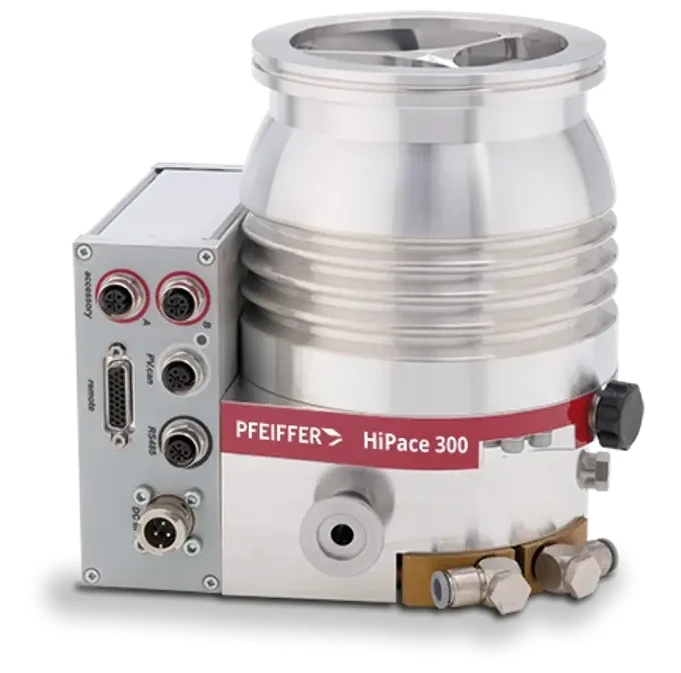
Pfeiffer Vacuum HiPace 300 with TC 110
Pfeiffer Vacuum HiPace 300 with TC 110 — Turbomolecular Vacuum Pumps with Pumping speed 936 m³/h.
The Pfeiffer Vacuum HiPace 300 is a compact turbomolecular pump driven by the TC 110 converter, delivering 260 l/s (N₂), 255 l/s (Ar, He) and 220 l/s (H₂) with a DN 100 ISO-K/ISO-F/CF-F inlet. Positioned mid-series between the 13 l/s HiPace 10 Neo and the 1250–1450 l/s HiPace 1200–1800 family, it targets leak detection, lab vacuum and semiconductor process tools.
Direct drop-in replacements
Full specifications
| Pumping speed | 260.0 l/s (N₂) Ar: 255.0 l/s · He: 255.0 l/s · H₂: 220.0 l/s |
| Compression ratio | 1*10^(11) (N₂) Ar: 1*10^(11) · He: 1*10^(8) · H₂: 9*10^(5) |
| Fore-vacuum max | 15.0 hPa (N₂) |
| Gas throughput | 2.0 hPa l/s (Ar @ final rotational speed) He @ final rotational speed: 8.0 hPa l/s · H₂ @ final rotational speed: 14.0 hPa l/s · N₂ @ final rotational speed: 5.0 hPa l/s |
| Run-up time | 3.5 min |
| Communication interfaces optional mfr | Profibus, Devicenet,Semi E74 |
| Weight | 6.2 kg |
| Mounting orientation mfr | arbitrary |
| Inlet flange | DN 100 ISO-K/ISO-F/CF-F |
| Outlet flange | DN 16 ISO-KF /G 1/4" |
| Noise level | 50.0 dBA |
| Communication interfaces standard mfr | RS-485, remote |
Description
Architecture and positioning within the Hipace series
- The HiPace 300 uses an optimized rotor geometry with enhanced gas-load handling and hybrid bearing technology with dedicated bearing lubrication, aimed at long service life and low lubricant-related contamination.
- Patented laser balancing keeps noise at 50 dBA and vibration low, making this modification appropriate for vibration-sensitive setups (surface analysis, metrology) — optionally combined with the vibration damper accessory.
- At 6.2 kg it is far lighter than the HiPace 1200/1500/1800 siblings (1250–1450 l/s class, TC 1200 controller), while offering roughly 20× the speed of the HiPace 10 Neo — the series' mid-range workhorse rather than an entry-level or high-throughput option.
Behavior under load and across gases
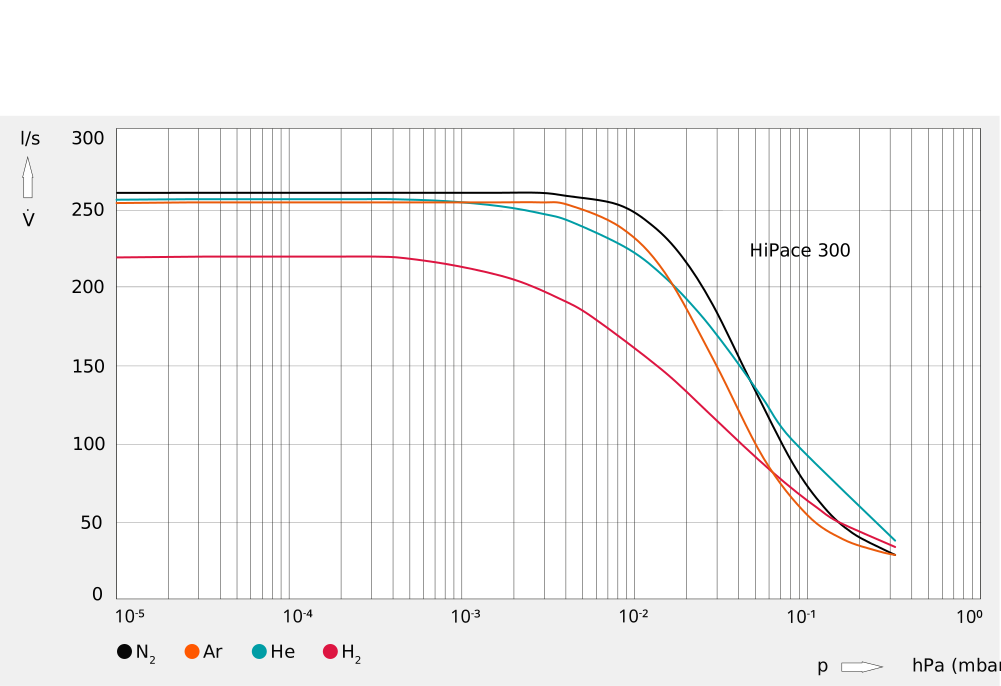
- Pumping speed is nearly flat across working gases: 260 l/s (N₂), 255 l/s (Ar, He) and 220 l/s (H₂), so light-gas processes do not suffer a severe speed collapse.
- Compression ratios are steeply gas-dependent: 1·10¹¹ for N₂ and Ar, 1·10⁸ for He, but only 9·10⁵ for H₂. Ultimate hydrogen partial pressure is therefore dominated by forevacuum quality; a capable backing pump is mandatory for low H₂ goals.
- Gas throughput at final rotational speed is 14 hPa·l/s (H₂), 8 hPa·l/s (He), 5 hPa·l/s (N₂) and 2 hPa·l/s (Ar). Continuous process gas load must stay within these limits; exceeding them degrades the pumping mechanism.
- Maximum forevacuum pressure is 15 hPa (N₂); run-up to full speed takes 3.5 min.
Installation, connection and control
- Inlet is DN 100 ISO-K/ISO-F/CF-F; foreline is DN 16 ISO-KF or G 1/4" — size the chamber flange and backing line accordingly.
- Mounting orientation is arbitrary, enabling compact or unusual chamber layouts.
- Standard interfaces are RS-485 (e.g., Pfeiffer protocol) and hardwired remote I/O; Profibus, DeviceNet and SEMI E74 fieldbus are optional.
- Accessories not in base delivery include mains/connecting cables, power supply kit with display unit, mounting kit, safety valve, venting accessories, power-failure venting unit and vibration damper.
Integration & Operating Notes
The pump loses its compression function if backing pressure at the DN 16 outlet exceeds 15 hPa (N₂) at maximum throughput. Size the backing pump for the worst-case process gas load, especially for hydrogen processes where the low H₂ compression ratio (9·10⁵) already makes ultimate pressure forevacuum-dependent.
At final rotational speed the pump tolerates 14 hPa·l/s (H₂), 8 hPa·l/s (He), 5 hPa·l/s (N₂) and 2 hPa·l/s (Ar). Process recipes with pulsed or continuous gas inlet must be checked against these limits, as exceeding them risks rotor instability and loss of pumping action in the molecular-flow range.
The pump can be installed in any orientation, simplifying compact chamber layouts. Chamber interface is DN 100 ISO-K/ISO-F/CF-F; use the optional mounting kit for standardized installation, and specify the safety valve where inlet sealing against oil backstreaming on shutdown is required. Weight is only 6.2 kg, so flange support is normally sufficient.
The TC 110 converter offers RS-485 and hardwired remote as standard. Profibus, DeviceNet and SEMI E74 interfaces are optional variants — confirm the correct converter configuration at ordering. Sequence the process start so gas load is applied only after the 3.5 min run-up to final speed.
Hybrid bearings with dedicated lubrication give a long bearing service life, but sudden power loss must be handled by venting to protect pump and chamber. Specify the power-failure venting unit for systems operating unattended; standard venting accessories are available for controlled venting procedures.
The base pump with TC 110 does not include mains/connecting cables, the power supply kit with display unit, or fieldbus hardware — these are ordered separately as accessories. Verify the complete electrical accessory set before commissioning to avoid delays at installation.
Selection & Integration Q&A
Choose the HiPace 300 for ~260 l/s (N₂) needs in leak detection, load-lock or lab/process applications with compact 6.2 kg footprint. Step up to HiPace 1200–1800 (1250–1450 l/s, TC 1200) for high-throughput chambers; pick HiPace 10 Neo (13 l/s) only for small analyzers or ion pumps.
The foreline must keep pressure below 15 hPa (N₂) at full gas load; because the H₂ compression ratio is only 9·10⁵, ultimate H₂ pressure depends heavily on backing quality. Use a DN 16 ISO-KF or G 1/4" foreline sized for up to 14 hPa·l/s H₂ throughput, with a backing pump holding low foreline pressure.
Mounting orientation is arbitrary. Laser-balanced rotor keeps noise at 50 dBA and vibration low, so no enclosure is normally needed; add the optional vibration damper for vibration-sensitive instruments (electron optics, surface analysis). Allow 3.5 min run-up before applying process gas load.
Not included in base delivery: mains/connecting cables, power supply kit with display unit, mounting kit, safety valve, venting accessories, power-failure venting unit, vibration damper and fieldbus hardware. Control is via RS-485/remote standard; Profibus, DeviceNet or SEMI E74 must be specified as options.
Markets & Applications
- 3D printing
- Leak Detection and EoL Testing
- Leak Detection and EoL Testing (Master)
- Laboratory Vacuum
- Lab Vacuum
- Mass spectromer
- Green Energy Generation
- Cryogenics
- High Energy Physics
- mass spectrometry
- Ultra-High Vacuum
- Surface Analysis
- ALD
- Inspection & Metrology
- Ion Implantation
- Light deposition
Dimensional Drawings & Technical Documentation
Dimensional drawings
Click drawing to inspect vector dimensions