
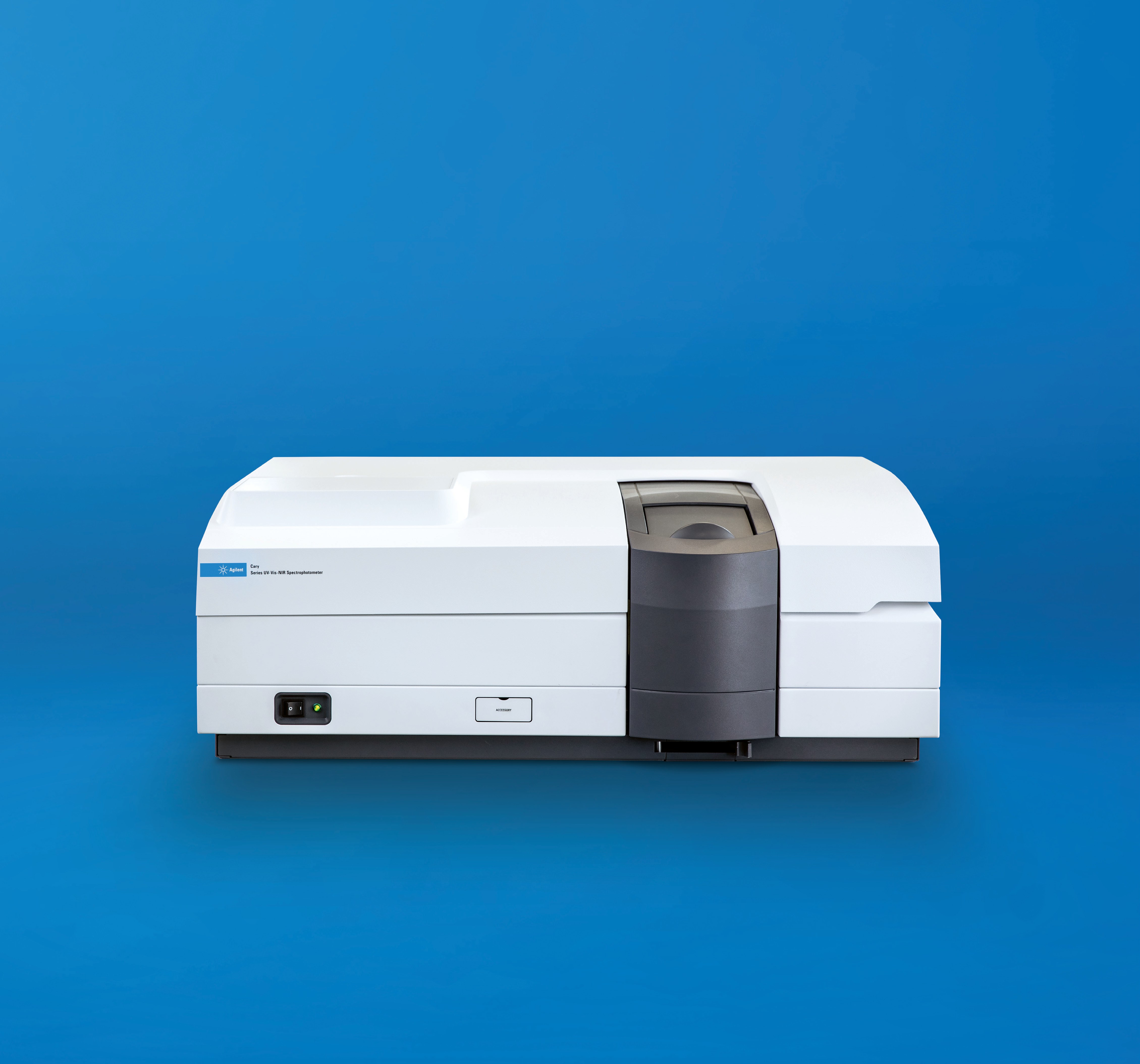
Agilent Technologies Cary 5000 UV-Vis-NIR spectrophotometer
Agilent Technologies Cary 5000 UV-Vis-NIR spectrophotometer — Molecular spectroscopy.
The Cary 5000 is a double-beam UV-Vis-NIR spectrophotometer built on an out-of-plane double Littrow monochromator with silica-overcoated optics on a floating solid aluminium casting. Its InGaAs NIR detector and PbSmart optical design extend coverage beyond the 175–900 nm range shared with the Cary 4000, with the NIR region optimized at 1200–1800 nm. It serves as the mid-range NIR-capable member of the Cary 4000/5000/6000i series for materials and chemical spectroscopy.
Agilent Technologies Cary Series — Model Comparison & Selection
| Model | Wavelength range | Focused beam diameter, mm | Integrating sphere diameter, mm | Temperature range, °C |
|---|---|---|---|---|
| Cary 5000 UV-Vis-NIR spectrophotometer Current | 175...900 | — | — | — |
| Cary 3500 | — | 1.5 | — | 5...110 |
| Cary 3500 Compact UV-Vis Spectrophotometer | — | 1.5 | — | 5...110 |
| Cary 3500 Flexible UV-Vis, Large Sample Compartment | — | 1.5 | — | — |
| Cary 4000 UV-Vis | 175...900 | — | 150 | — |
| Cary 60 | 190...1,100 | — | — | — |
| Cary 6000i UV-Vis-NIR | 175...900 | — | 150 | — |
Full specifications
| Wavelength range | 175...900 nm |
| Optimized NIR region mfr | 1200...1800 nm |
| NIR detector mfr | InGaAs InGaAs |
| Optical design mfr | PbSmart PbSmart |
| Monochromator design mfr | out-of-plane double Littrow Littrow |
| Optics mfr | silica overcoated overcoated |
| Optical isolation mfr | floating solid aluminium casting casting |
| Lamp replacement mfr | pre-aligned, plug-and-go go |
| Slits mfr | fixed, in NIR as well as UV-Vis Vis |
Description
Construction and series positioning
- Out-of-plane double Littrow monochromator with silica-overcoated optics, mounted on a floating solid aluminium casting for optical isolation.
- InGaAs NIR detector with PbSmart optical design; fixed slits in both the UV-Vis and NIR regions.
- Within the Cary 4000/5000/6000i series, the Cary 4000 covers 175–900 nm only, while the Cary 6000i extends to 175–1800 nm; the Cary 5000 sits between them with NIR coverage optimized at 1200–1800 nm. The Cary 3500 siblings are a separate compact/flexible platform, not this double-beam architecture.
- Pre-aligned, plug-and-go lamp replacement reduces downtime during source changes.
Behavior and measurement modes
- The instrument is a double-beam system with a removable sample compartment floor for large apparatus; once the floor is removed, optical alignment with respect to the floor is lost and must be re-established before microcell analyses.
- Solid sample holders (Cary 4000/5000/6000i/7000 only) mount on a LockDown base plate; the slide must mask the beam before it reaches the sample to minimize scattering.
- Nitrogen purging is supported for the Cary 4000/5000/6000i/7000 group, with separate flow control for the instrument and the sample compartment.
Installation, control and operation
- Connects to the computer via a shielded IEEE-488 cable; GPIB communication uses a National Instruments USB-GPIB-HS+ converter installed after Cary WinUV software.
- The sample compartment 15-pin D-range connector carries high-voltage pins at -1000 VDC and +125 VDC on this model; one connector is dedicated to Agilent internal and external diffuse reflectance accessories.
- A Universal Power Supply adapts to the mains voltage, but the actual supply must still be verified.
- Cary WinUV software includes a Validate application for performance tests against specification; failed tests require an Agilent representative.
Integration & Operating Notes
The system needs at least 50 mm (2 in.) on the sides and 150 mm (6 in.) at the rear for free air circulation. Insufficient clearance causes overheating and impaired performance, so bench depth and adjacent equipment placement must be planned around these figures before installation.
The 15-pin D-range connector in the sample compartment exposes high-voltage pins rated -1000 VDC and +125 VDC on the Cary 4000/5000/7000. Accessory selection and service procedures must account for these voltages; only Agilent internal and external DRAs should be connected to the DRA-dedicated connector to avoid shock hazard.
Nitrogen purging requires an operating pressure of 83 to 172 kPa (12 to 25 psig) and clean flexible plastic (PVC or equivalent) tubing of 6 mm (1/4 in.) internal diameter. Rubber tubing must never be used because internal talc treatment can be blown into the optical system and damage the optics; compressed nitrogen must be dry, oil-free and uncontaminated.
GPIB communication between the computer and the spectrophotometer uses a National Instruments USB-GPIB-HS+ converter. The procedure requires Cary WinUV software to be installed first, then the converter connected between instrument and computer USB port; reversing the order can leave the interface unrecognized.
Removing the floor of the Cary 4000/5000/6000i/7000 sample compartment loses optical alignment with respect to the floor. Before any microcell analyses, the optics must be realigned; otherwise beam centering on the cell aperture is no longer valid and measurements are unreliable.
Before changing the deuterium or visible lamp, switch off the instrument, remove the power supply cable and let the lamps cool; surfaces and brackets remain hot and at high voltage. New lamps must be handled by the base with a soft cloth because touching the glass envelope reduces lamp efficiency.
Selection & Integration Q&A
Pick the Cary 5000 when measurements need NIR coverage beyond the Cary 4000's 175–900 nm, with the NIR region optimized at 1200–1800 nm. Choose the Cary 6000i if you need coverage to 175–1800 nm; choose the Cary 4000 if UV-Vis only suffices.
Use a shielded IEEE-488 cable and a National Instruments USB-GPIB-HS+ converter, installing Cary WinUV first. For purging, supply dry oil-free nitrogen at 83–172 kPa through 6 mm ID plastic tubing, with 0–20 L/min instrument and 0–10 L/min sample compartment flow.
Cell holders, solid sample holders, LockDown base plate and DRAs are separate accessories requiring alignment with the Align application. Lamp replacement is pre-aligned plug-and-go but lamps are handled separately; two rear fuses are operator-replaceable, and the Validate application checks performance after service.