
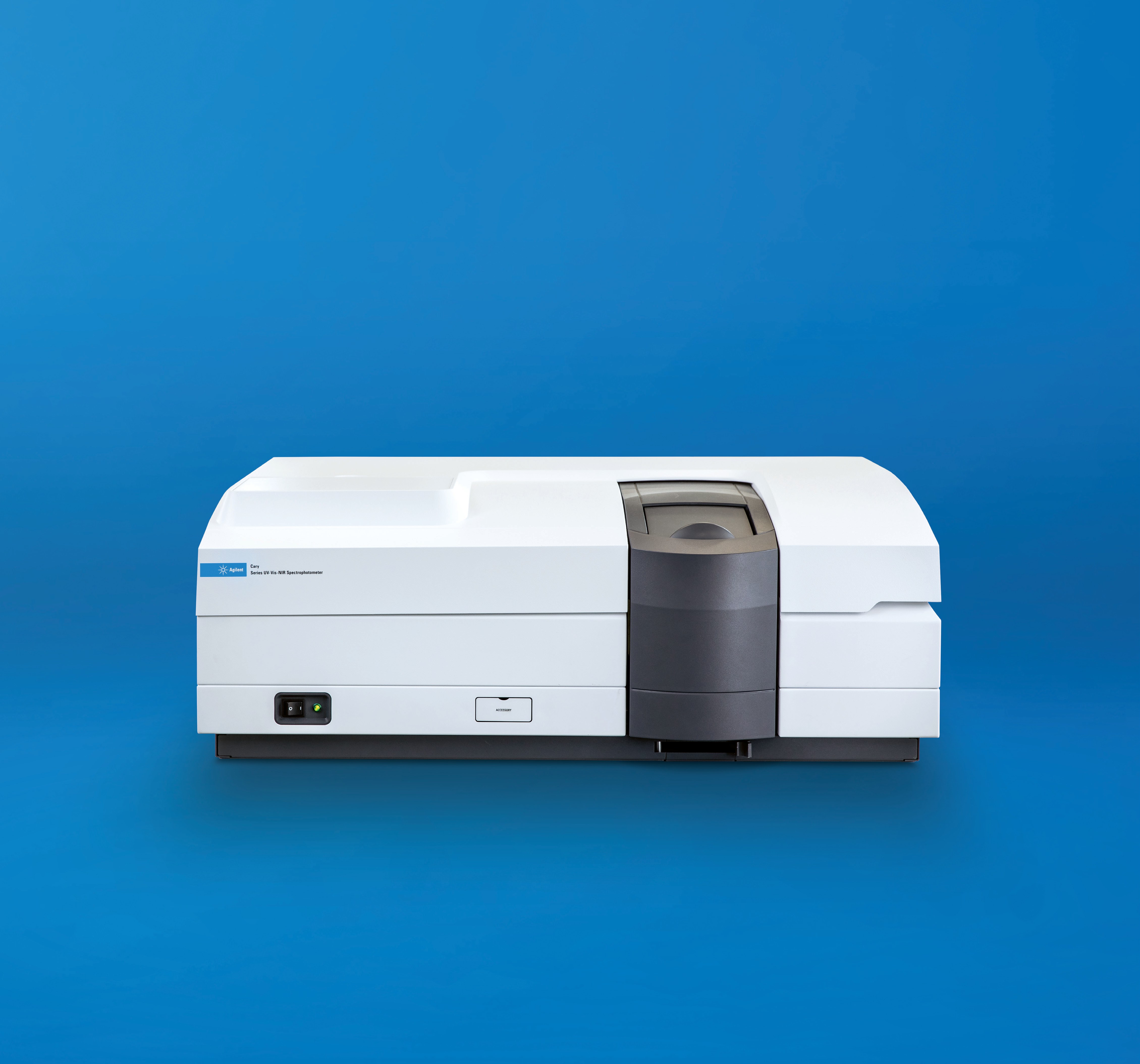
Agilent Technologies Cary 6000i UV-Vis-NIR
Agilent Technologies Cary 6000i UV-Vis-NIR — Molecular spectroscopy.
The Cary 6000i is a UV-Vis-NIR spectrophotometer with an out-of-plane double Littrow monochromator and PbSmart optics, covering 175–900 nm in UV-Vis and optimized for 1200–1800 nm NIR using an InGaAs detector. It is the NIR-extended modification of the Cary 4000/5000 series, distinguished by fixed slits and a floating solid aluminium optical casting. It serves materials characterization and NIR-region measurements where extended wavelength coverage to 1800 nm is required.
Agilent Technologies Cary Series — Model Comparison & Selection
| Model | Wavelength range | Focused beam diameter, mm | Integrating sphere diameter, mm | Temperature range, °C |
|---|---|---|---|---|
| Cary 6000i UV-Vis-NIR Current | 175...900 | — | 150 | — |
| Cary 3500 | — | 1.5 | — | 5...110 |
| Cary 3500 Compact UV-Vis Spectrophotometer | — | 1.5 | — | 5...110 |
| Cary 3500 Flexible UV-Vis, Large Sample Compartment | — | 1.5 | — | — |
| Cary 4000 UV-Vis | 175...900 | — | 150 | — |
| Cary 5000 UV-Vis-NIR spectrophotometer | 175...900 | — | — | — |
| Cary 60 | 190...1,100 | — | — | — |
Full specifications
| Wavelength range | 175...900 nm |
| Integrating Sphere Diameter | 150 mm |
| Optimized NIR region mfr | 1200...1800 nm |
| NIR detector mfr | InGaAs InGaAs |
| Optical design mfr | PbSmart PbSmart |
| Monochromator design mfr | out-of-plane double Littrow Littrow |
| Optics mfr | silica overcoated overcoated |
| Optical isolation mfr | floating solid aluminium casting casting |
| Lamp replacement mfr | pre-aligned, plug-and-go go |
| Slits mfr | fixed, in NIR as well as UV-Vis Vis |
| NIR grating mfr | 600 lines/mm |
| internal diffuse reflectance accessory range mfr | 110 mm |
| external diffuse reflectance accessory range mfr | 150 mm |
Description
Construction and series positioning
- The Cary 6000i shares the 175–900 nm UV-Vis range with the Cary 4000 but extends into the NIR to 1800 nm, with the NIR region optimized at 1200–1800 nm.
- Optical architecture: out-of-plane double Littrow monochromator, PbSmart optical design, silica overcoated optics, and a floating solid aluminium casting for optical isolation.
- Slits are fixed in both the UV-Vis and NIR regions, unlike variable-slit configurations.
- The NIR detector is InGaAs; the sibling Cary 5000 extends to 3300 nm, while the Cary 6000i stops at 1800 nm.
Behavior and measurement range
- Wavelength coverage is 175–900 nm for UV-Vis and extends to 1800 nm for NIR, with the 1200–1800 nm region designated as optimized.
- No digitized curve points or performance verification data are available in the supplied facts; behavior under load or in different modes cannot be quantified beyond the stated ranges.
Installation, control and operation
- Lamp replacement is pre-aligned and plug-and-go, reducing realignment effort after lamp changes.
- The brochure digest provides no further installation, connection, or control specifics; electrical, interface, and environmental parameters are not supplied in the verified facts.
Selection & Integration Q&A
Choose the Cary 6000i when measurements must extend into the NIR to 1800 nm with the 1200–1800 nm region optimized and an InGaAs detector. Choose the Cary 4000 for UV-Vis only to 900 nm, or the Cary 5000 when coverage to 3300 nm is required.
The verified facts do not specify electrical supply, interface, or accessory requirements. Confirm power, control interface, and any sample-handling accessories with the vendor before integration, since the brochure digest provides no connection or controller details.
The optical system sits on a floating solid aluminium casting, so a stable bench location is advisable. No duty-cycle, warm-up, or environmental limits are stated in the supplied facts; consult the full manual for those constraints.
Lamp replacement is pre-aligned and plug-and-go, but no service interval, consumable list, or accessory/cable inventory is given in the verified facts. Confirm lamp part numbers, cables, and any sample accessories separately, as they are not documented here.