
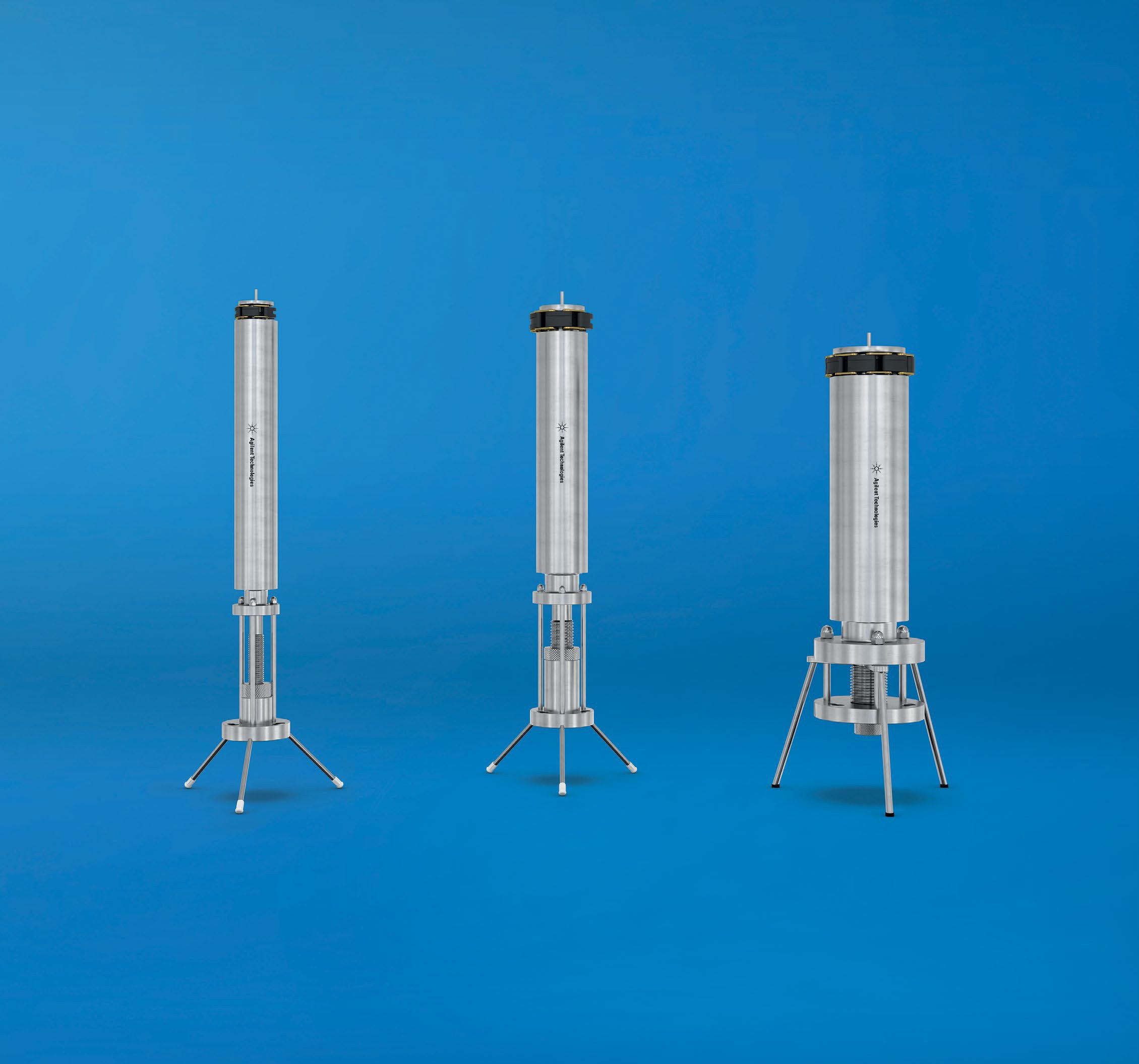
Agilent Technologies Automated LC/MSD purification| High-precision| Complex mixtures
Agilent Technologies Automated LC/MSD purification| High-precision| Complex mixtures — Liquid chromatography.
The Agilent Automated LC/MSD purification system is a preparative HPLC configuration built around the 1260 Infinity II Preparative Binary Pump, Preparative Autosampler (G7157A), Variable Wavelength Detector, and LC/MSD (G6125B) for mass-directed fraction collection. It targets complex mixtures requiring high-precision purification, with demonstrated 97% fraction purity and 96% recovery at 1 mL/min and 254 nm detection. Column inside diameters from 1 to 3 inches (27 to 75 mm) are supported when paired with Load & Lock columns in DAC or SAC mode.
Agilent Technologies Preparative HPLC Systems Series — Model Comparison & Selection
Full specifications
| Detection wavelength | 254 nm |
| Fraction Purity | 97 % |
| Fraction Recovery | 96 % |
| Plate Count | 40606 Nth/meter |
| Retention Time | 15.18 min |
| Typical Flow Rate | 1 mL/min |
| Uv Threshold | 1 mAU/s |
| Productivity range mfr | Micrograms Micrograms |
| Asymmetry mfr | 1.27 |
| Column inside diameter range mfr | 9.4 mm |
| Gradient end point mfr | 3.50 % B |
| Stop time mfr | 5.10 minutes |
| Membrane pore size mfr | 0.22 μm |
| Column Inner Diameter | 1...3 in |
Description
Construction and series positioning
This model is the mass-directed purification member of the 1260 Infinity II preparative family, distinguished from the 1260 Infinity II Manual Preparative LC System by its automated autosampler (G7157A) and integrated LC/MSD XT (G6125B) for trigger-based fraction collection. It sits above the analytical-scale purification siblings (1220 Infinity II, 1260 Analytical-Scale, 1260 Bio-Inert) in load capacity, accepting preparative columns up to 3 in id, and below the 1290 Infinity II Preparative platform in pressure capability. The binary pump, variable wavelength detector, and valve-based fraction collector form the core; the open-bed collector is an alternative module from the same portfolio.
Behavior under load and in different modes
- At 1 mL/min and 254 nm, the system resolves complex mixtures with 40,606 plates/m, retention time 15.18 min, and asymmetry 1.27, yielding 97% fraction purity and 96% recovery.
- The UV threshold of 1 mAU/s governs slope-based fraction triggering; the LC/MSD adds mass-triggered collection for co-eluting compounds.
- Gradient end point 3.50 %B and stop time 5.10 min define a narrow scouting run; scale-up to 1–3 in id columns uses the same binary pump with Load & Lock columns in DAC or SAC mode.
- Membrane pore size 0.22 µm applies to solvent filtration upstream of the pump; productivity range extends to micrograms of purified compound per run.
Installation, connection, and control
- The autosampler, detector, fraction collector, and LC/MSD are controlled through OpenLAB CDS ChemStation; the MSD trigger requires the software's purification workflow.
- Solvent lines must be filtered at 0.22 µm before the binary pump; the preparative flow path uses standard stainless steel connections, with water-jacketed columns available for temperature control.
- The LC/MSD XT requires its own vacuum pump and exhaust; the fraction collector needs the valve-based or open-bed configuration selected at order.
Integration & Operating Notes
Load & Lock columns are offered only in 1, 2, and 3 in id (27–75 mm); a method scaled to a 9.4 mm analytical column cannot be run on this preparative flow path without a column change. Verify the column inside diameter against the packing station size before scheduling purification runs.
Mass-directed collection depends on the LC/MSD XT signal reaching OpenLAB CDS ChemStation; if the MSD is not configured as a trigger source, the valve-based fraction collector falls back to time or UV-slope windows only. Confirm the trigger source in the method before the run, because a missing MSD signal silently changes the collection logic.
The 0.22 µm membrane pore size is the specified filtration cutoff for solvents entering the binary pump. Particulate carryover at preparative flow rates can score pump seals and plug the column frit; install the filter on each solvent line and replace it on the maintenance schedule rather than waiting for pressure drift.
Load & Lock columns ship with standard stainless steel water jackets, but the temperature-control circulator is not part of the column or system delivery. Plan bench space and a coolant loop for the jacket if the method requires column temperature control; otherwise the jacket runs at ambient.
Selection & Integration Q&A
Pick this model when fraction identity must be confirmed by mass and collection is automated: the G7157A autosampler and G6125B LC/MSD XT replace manual injection and UV-only triggering. Choose the Manual Preparative system for UV-directed work without MS confirmation, and the analytical-scale 1260 when column id stays below preparative range and sample load is limited.
The LC/MSD XT needs its own vacuum pump and exhaust line, and OpenLAB CDS ChemStation must be licensed for the purification workflow to pass the MSD trigger to the valve-based fraction collector. Solvent lines require 0.22 µm filters, and preparative columns must be Load & Lock type in 1–3 in id with a matching packing station.
Base delivery covers the modules but not the 0.22 µm solvent filters, pump seals, or replacement column frits, which are consumables on the maintenance schedule. The water-jacket circulator, MSD vacuum pump, and packing station for 1–3 in id columns are separate items. OpenLAB CDS ChemStation licenses and the purification workflow option are ordered separately.