
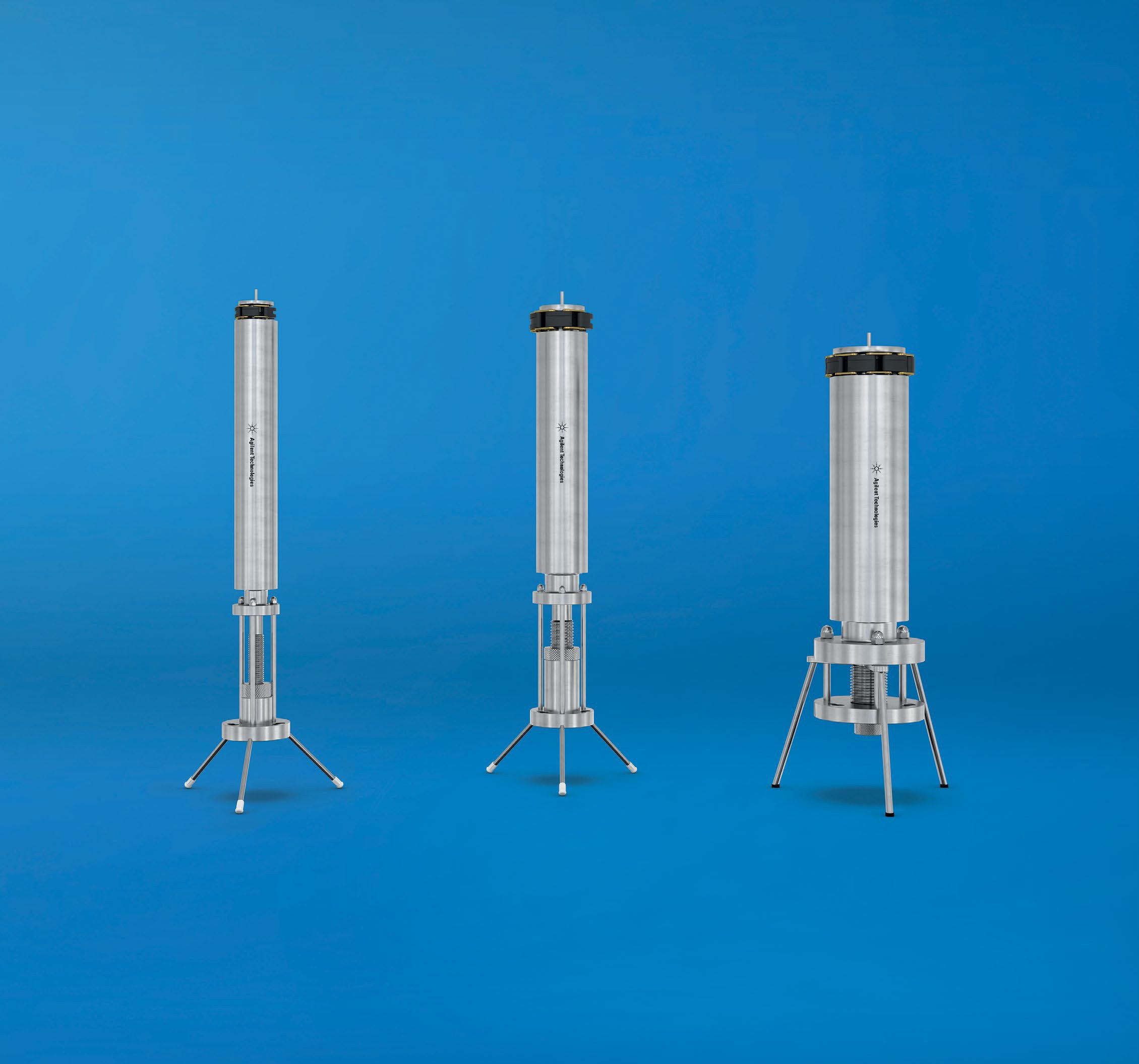
Agilent Technologies 1260 Infinity II Manual Preparative LC System
Agilent Technologies 1260 Infinity II Manual Preparative LC System — Liquid chromatography with Pumping speed 0.012 m³/h.
The 1260 Infinity II Manual Preparative LC System is a preparative-scale HPLC configuration built around a manual injector and open-bed fraction collection, accepting columns of 1 to 3 in internal diameter. It sits between the analytical-scale purification systems and the UV-directed preparative LC system in the 1260 series, and is intended for hands-on purification of milligram-to-gram quantities where the operator controls injection and fraction cutting.
Agilent Technologies Preparative HPLC Systems Series — Model Comparison & Selection
Full specifications
| Pumping speed | 200 mL/min |
| Plate Count | 40606 Nth/meter |
| Retention Time | 15.18 min |
| Typical Flow Rate | 1 mL/min |
| Productivity range mfr | Grams Grams |
| Asymmetry mfr | 1.27 |
| pressure at 50 mL/min mfr | 600 bar |
| pressure at 200 mL/min mfr | 420 bar |
| maximum flow rate (1260) mfr | 50 mL/min |
| sample capacity (Open-Bed) mfr | 864 samples |
| fraction capacity (Open-Bed) mfr | 432 fractions |
| maximum fraction capacity mfr | 1296 fractions |
| fractions per module (1260) mfr | 216 fractions |
| expandable fraction capacity (1260) mfr | 648 fractions |
| injection volume (1260 sampler) mfr | 3.6 mL |
| sample capacity (1260 sampler) mfr | 132 samples |
| sample loading increase (Load & Lock) mfr | 20 |
| Column Inner Diameter | 1...3 in |
| maximum column inner diameter (1290) mfr | 50 mm |
| maximum column inner diameter (1260) mfr | 30 mm |
Description
Construction and positioning in the series
The 1260 Infinity II Manual Preparative LC System is the manual-injection member of the 1260 preparative family. Unlike the UV-based preparative system, which automates fraction detection and cutting, this configuration relies on the operator to inject via a manual injector and to collect fractions from an open-bed collector. It is distinguished from the 1220 and 1260 analytical-scale purification systems by its preparative column capacity: the load-and-lock column range covers 1 to 3 in internal diameter (27 to 75 mm), whereas analytical-scale siblings are limited to analytical columns. The Bio-Inert variant is the choice when biological samples require inert flow path; this standard preparative system is the general-purpose option.
Behavior and performance context
Verified performance data for this exact configuration are limited to a plate count of 40,606 N/m, a retention time of 15.18 min and a typical flow rate of 1 mL/min, with peak asymmetry of 1.27. These values describe a chromatographic separation at analytical-like flow on a preparative column, not a high-throughput production run; the system is therefore suited to method development and scale-up studies before transferring to automated preparative platforms. The 1 to 3 in column range allows the same hardware to run small and larger preparative columns, but the operator must expect flow rate and backpressure to scale with column diameter.
Installation, control and operation
From the portfolio documentation, the system is assembled from preparative modules: column organizer, column compartment, manual injector, open-bed sampler/collector, detectors and fraction collector. The load-and-lock columns are available in dynamic axial compression (DAC) and static axial compression (SAC) modes with standard stainless steel water jackets, and mobile packing stations exist for 1, 2 and 3 in id columns. Installation therefore requires planning for column packing and unpacking equipment, jacket cooling water, and manual fraction handling. Control is local and manual for injection and collection; no automated fraction-cutting logic is part of this configuration.
Integration & Operating Notes
The system is documented for load-and-lock columns of 1 to 3 in internal diameter (27 to 75 mm). Fitting a column outside this range, or a non-load-and-lock column, requires separate fittings and is not covered by the system documentation; confirm column end fittings and jacket connections before ordering.
Load-and-lock columns are offered in dynamic axial compression (DAC) and static axial compression (SAC) modes. The packing station and operating procedure differ between modes, so the mode must be fixed at the selection stage; the mobile packing stations are sized for 1, 2 and 3 in id columns and are not interchangeable across diameters.
Standard stainless steel water jackets are part of the column hardware. Installation planning must provide jacket coolant supply and return lines at the column location; the jacket is a column feature, not a system module, so the coolant circuit is the user's responsibility.
This configuration uses a manual injector and an open-bed sampler/collector rather than an automated fraction collector with UV-triggered cutting. Operators must plan fraction cutting by hand and provide the detector signal display; the UV-based preparative sibling is the alternative when automated fraction detection is required.
Mobile packing stations are listed for 1, 2 and 3 in id columns. Packing or unpacking a column without the correct station for its diameter is not supported by the documentation; schedule station availability and operator training as part of commissioning rather than treating packing as an accessory.
Selection & Integration Q&A
Pick the manual system when the operator will inject by hand and cut fractions from an open-bed collector, and when columns of 1–3 in id are needed. Choose the UV-based preparative system for automated UV-triggered fraction cutting; choose the 1220/1260 analytical-scale systems for analytical columns only.
Load-and-lock columns in 1, 2 or 3 in id, in either DAC or SAC mode, with standard stainless steel water jackets. A mobile packing station matched to the column diameter is required for packing and unpacking; these are separate items from the LC system itself.
The columns carry standard stainless steel water jackets, so coolant supply and return lines must be routed to the column position. The 1–3 in id columns and their packing stations occupy bench space beyond the LC modules; plan the column organizer and packing station footprint before installation.
Preparative load-and-lock columns, the mobile packing station for the chosen column diameter, and jacket coolant plumbing are separate from the LC system. Fraction collection vessels for the open-bed collector and any detector-specific flow cells are also user-supplied.