
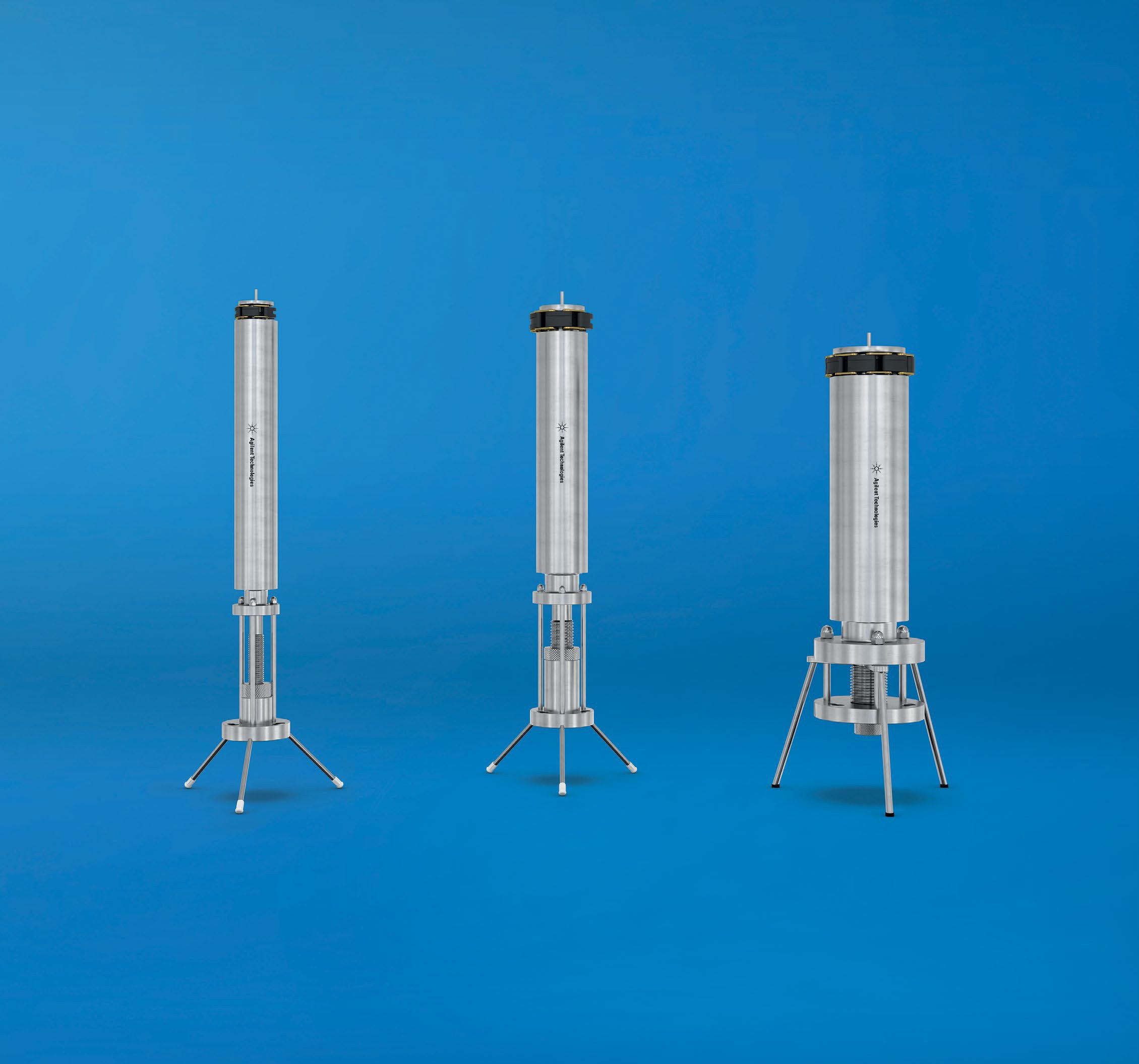
Agilent Technologies High-throughput Purification | Drug discovery | Biological
Agilent Technologies High-throughput Purification | Drug discovery | Biological — Liquid chromatography.
The Agilent high-throughput purification system is a preparative HPLC configuration for drug discovery and biological applications, accepting columns of 1–3 in internal diameter. It achieves 97% fraction purity and 96% recovery at 1 mL/min with 254 nm detection. This modification is positioned for high-throughput purification within the InfinityLab preparative series.
Agilent Technologies Preparative HPLC Systems Series — Model Comparison & Selection
Full specifications
| Detection wavelength | 254 nm |
| Fraction Purity | 97 % |
| Fraction Recovery | 96 % |
| Plate Count | 40606 Nth/meter |
| Retention Time | 15.18 min |
| Typical Flow Rate | 1 mL/min |
| Uv Threshold | 1 mAU/s |
| Productivity range mfr | Micrograms Micrograms |
| Asymmetry mfr | 1.27 |
| Column inside diameter range mfr | 9.4 mm |
| Gradient end point mfr | 3.50 % B |
| Stop time mfr | 5.10 minutes |
| Membrane pore size mfr | 0.22 μm |
| Column Inner Diameter | 1...3 in |
Description
Construction and series positioning
- This model is a preparative HPLC system configured for high-throughput purification in drug discovery and biological workflows, distinguished from analytical-scale siblings (1220 Infinity II, 1260 Analytical-Scale, 1260 Bio-Inert, 1260 Infinity II Manual Preparative) by its support for preparative column dimensions.
- The system accommodates columns with internal diameters from 1 to 3 inches (27 to 75 mm), as detailed in the Load & Lock column documentation, which covers both dynamic axial compression (DAC) and static axial compression (SAC) modes.
- Standard stainless steel water jackets and mobile packing stations for 1, 2, and 3 inch id columns are part of the column ecosystem, enabling scalable purification.
Performance characteristics
- Under typical operating conditions, the system delivers a plate count of 40,606 N/m, retention time of 15.18 min, and asymmetry of 1.27, indicating efficient separation.
- Fraction purity reaches 97% with 96% recovery, supported by UV detection at 254 nm and a UV threshold of 1 mAU/s for fraction triggering.
- The gradient end point is 3.50% B with a stop time of 5.10 minutes, reflecting a rapid purification cycle suitable for high-throughput screening.
- Productivity range is specified in micrograms, aligning with analytical-to-preparative scale purification.
Installation and operation
- The system integrates with InfinityLab preparative modules including binary pump, autosampler, variable wavelength detector, and fraction collector, as described in the technical overview.
- Membrane pore size of 0.22 µm is noted for filtration, likely in mobile phase preparation or sample cleanup.
- Control is via OpenLAB CDS ChemStation software, which manages gradient programming, fraction collection, and data analysis.
Integration & Operating Notes
Exceeding the maximum pressure rating of the preparative flow path can damage columns and seals. Always verify backpressure at the typical flow rate of 1 mL/min with the installed column dimensions (1–3 in id) and adjust gradient or flow if pressure approaches the limit.
The 0.22 µm membrane pore size referenced in the column documentation indicates filtration of mobile phases and samples. Clogged filters cause baseline noise and pressure spikes; establish a replacement schedule based on solvent volume and sample load to maintain 97% fraction purity.
The UV threshold of 1 mAU/s is used to initiate peak-based fraction collection. Ensure the detector signal is properly calibrated and the threshold is set above baseline noise to avoid false triggers; integrate with the fraction collector via the control software for synchronized operation.
Selection & Integration Q&A
Choose this model for automated high-throughput purification with fraction collection and UV threshold triggering (1 mAU/s), achieving 97% purity and 96% recovery. The manual preparative system is suited for lower-throughput, hands-on operation without integrated automation.
The system integrates with InfinityLab fraction collectors (valve-based or open-bed) via the control software. Ensure the collector's tubing and fittings are compatible with the preparative flow path (1–3 in id columns) and that the UV threshold signal (1 mAU/s) is routed to trigger collection.
The base system does not include preparative columns (1–3 in id), mobile packing stations, or replacement membrane filters (0.22 µm). Additionally, solvent filtration kits, spare seals, and validation kits are typically ordered separately. Refer to the accessories list in the brochure for details.