
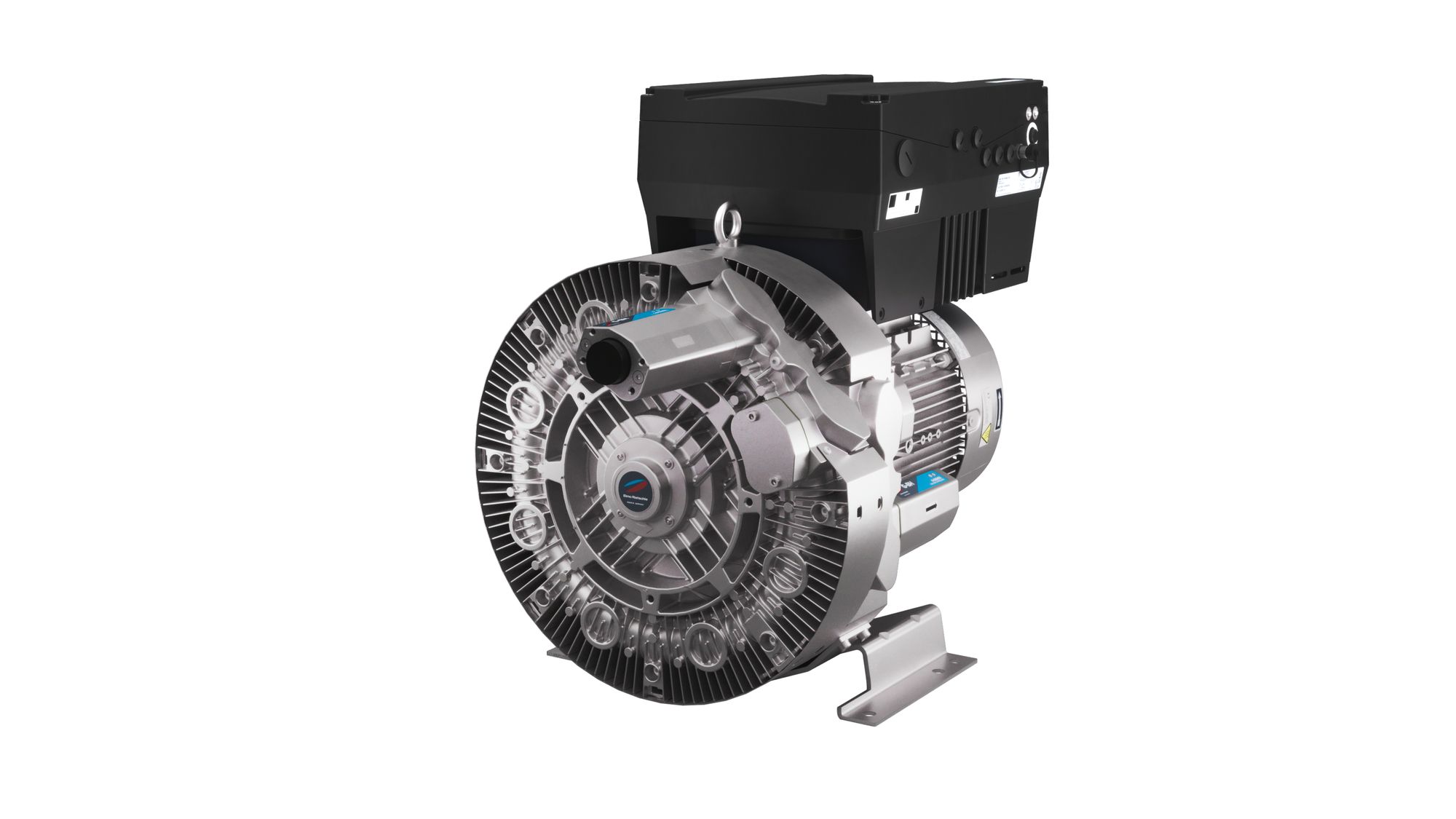
Elmo Rietschle 2BH741
Elmo Rietschle 2BH741 — Side-Channel / Regenerative Ring Blowers with Motor power 1.6 kW, Noise level 58 dB, Pumping speed 370 m³/h.
The 2BH741 is a side-channel blower from the G-BH7 series, driven by an IE3 efficiency-class motor and available in vacuum or compressor operation. It is configured for 50/60 Hz mains with Δ/Y voltage options, distinguishing it from smaller siblings like the 2BH721. It serves as a compact, IP55-protected air mover for industrial vacuum or pressure duties.
Elmo Rietschle G-BH7 Series — Model Comparison & Selection
| Model | Motor power, kW | Noise level, dB | Max. differential pressure, mbar | Weight, kg | Current, A | Voltage, V |
|---|---|---|---|---|---|---|
| 2BH741 Current | 1.3 | 63 | — | 26 | 6.3 | 190–210 |
| 2BH721 | 1 | 59 | -300 | 21 | 4.2 | 190–210 |
| 2BH7210 | 0.63 | 63 | -270 | 16 | 3.0 △ / 1.7 Y | 220-275 △ / 380-480 Y |
| 2BH722 | 1.1 | 58 | 480 | 28 | 4.8 UU / 2.4 U | 190-210 UU / 380-420 U |
| 2BH7220 | 0.81 | 58 | -440 | 24 | 4 | 220-275 / 380-480 Y |
| 2BH731 | 1.1 | 63 | -340 | 24 | 2.8–5.5 | 190-210 / 380-420 |
| 2BH7310 | 0.63 | 58 | 250 | — | 2.8 | 200-240 / 345-415 Y |
| 2BH732 | 1.3 | 64 | 440 | 33 | 3.2 | 190-210 / 380-420 |
| 2BH7320 | 3.5 | 77 | -510 | 48 | 6.5 | — |
| 2BH7410 | 2.6 | 73 | -230 | 33 | 5.2 | 400 |
| 2BH742 | 1.8 | 64 | 460 | 38 | 3.9–7.8 | 190-210 / 380-420 |
| 2BH7420 | 2.9 | 77 | -270 | 45 | 6.5 | 380 |
| 2BH751 | 1.8 | 68 | -340 | 33 | 7.8 UU | 190-210 UU / 380-420 U |
| 2BH7510 | 6.6 | 78 | 430 | 43 | 12.7 | 400 |
| 2BH752 | 2.5 | 64 | -520 | 50 | 12 | 190-210 / 380-420 |
| 2BH7520 | 4.3 | 77 | -520 | 57 | 8.7 | 400 V (-15%) … 480 V (+1 |
| 2BH753 | 5.3 | 69 | 950 | 72 | 17.1 | 190–210 |
| 2BH7530 | 7.5 | 70 | -610 | 80 | 16.2 | 400 |
| 2BH7610 | 5.8 | 80 | -410 | 55 | 12.7 | 380 |
| 2BH7620 | 8.8 | 79 | -530 | 77 | 16.2 | 400 |
| 2BH7630 | 16 | 80 | -500 | 121 | 29 | 400 |
Full specifications
| Motor power | 1.3 kW (50 Hz) 60 Hz: 1.6 kW |
| Noise level | 58 dB (50 Hz) 60 Hz: 63 dB |
| Pumping speed | 390 m³/hour (50 Hz) 60 Hz: 370 m³/hour |
| Ultimate pressure | -300 mbar (50 Hz) 60 Hz: -350 mbar |
| Approval mfr | UL 1450 and CAN/CSA C22.2 No. 68-09 (certificate |
| Max. differential pressure mfr | -300 mbar (50 Hz) |
| Max. differential pressure mfr | -350 mbar (60 Hz) |
| Efficiency mfr | IE3 (50 Hz) |
| Efficiency mfr | IE3 (60 Hz) |
| Order No. mfr | 2BH7410-0AK11-1 |
| Weight | 26 kg (50 Hz) 60 Hz: 26 kg |
| Current | 5.6 A (50 Hz) 60 Hz: 6.3 A |
| Frequency | 50 Hz (50 Hz) 60 Hz: 60 Hz |
| Power supply | 3~ 50/60 Hz |
| Voltage | 190-210 V (50 Hz) 60 Hz: 190-210 V |
| Motor efficiency class mfr | IE3 |
| Voltage (alt 60 Hz) mfr | 380-420 V (60 Hz) |
| Protection rating | IP55 |
| Sound pressure level mfr | 58 dB(A) (50 Hz) |
| Sound pressure level mfr | 63 dB(A) (60 Hz) |
Description
Construction and Series Positioning
The 2BH741 (type 2BH7410) is a side-channel (regenerative) blower in the G-BH7 series. Its IE3 motor sets it apart from lower-efficiency siblings, and its 50/60 Hz dual-frequency design with Δ/Y voltage options (220–240 VΔ / 380–420 VY at 50 Hz; 440–480 VY at 60 Hz) allows global deployment. Within the series, the 2BH741 sits above the 2BH721 and 2BH722 variants, offering a larger frame size for higher flow or pressure duties, though specific performance curves are not provided in the available facts.
Operation and Media
No digitized curve points or matched performance specs are available, so the exact pressure/vacuum range cannot be stated. The blower is intended for air or neutral gases in vacuum or compressor mode, as indicated by the data sheet scope. The IE3 motor and IP55 protection (insulation class F) support continuous industrial operation, but duty-cycle limits must be confirmed from the full manual.
Installation and Control
Electrical connection requires a 3-phase supply matching the selected Δ/Y configuration. The motor is approved to UL 1450 and CAN/CSA C22.2 No. 68-09 (certificate E225239), facilitating North American integration. No control interface or VFD compatibility details are provided; the blower is typically operated direct-on-line. Mounting and piping specifics are not detailed in the available digest, so standard side-channel blower practices (rigid base, flexible connectors) should be applied.
Integration & Operating Notes
The motor is wound for Δ or Y connection depending on mains voltage and frequency. Applying 400 V Y at 50 Hz to a Δ-configured motor will overexcite the winding and cause overheating. Always confirm the terminal link position against the nameplate before energizing.
Side-channel blowers generate vibration; rigid piping can transmit stress to the casing and cause fatigue. Install flexible connectors on inlet and outlet, and mount on a flat, rigid base with anti-vibration pads if noise or movement is a concern.
The 2BH741 can operate as a vacuum pump or compressor, but the internal flow path and connections may differ. Ensure the unit is ordered and configured for the intended duty, as reversing operation without proper modification can reduce performance or damage the blower.
Dust buildup on the intake filter reduces airflow and increases motor load. Check the filter every 500 operating hours or more frequently in dusty environments; clean or replace as needed to maintain cooling and performance.
Selection & Integration Q&A
Choose the 2BH741 when higher flow or pressure is required than the 2BH721/2BH722 can deliver. The 2BH741 has a larger frame and IE3 motor, but confirm exact performance from curves, as no data is provided here.
The 2BH741 requires a 3-phase supply matching its Δ/Y winding (e.g., 220–240 VΔ or 380–420 VY at 50 Hz). Use a motor protection circuit breaker set to the nameplate full-load current, and ensure the supply can handle starting current.
Mount on a rigid, vibration-damping base in a well-ventilated area. Ambient temperature limits are not specified in the available facts; consult the full manual. Ensure IP55 rating is not compromised by improper cable glands.
The base delivery typically excludes intake filters, flexible connectors, and mounting feet. Plan for regular filter cleaning every 500 hours and inspect bearings periodically. Specific service intervals are not detailed in the provided digest.