
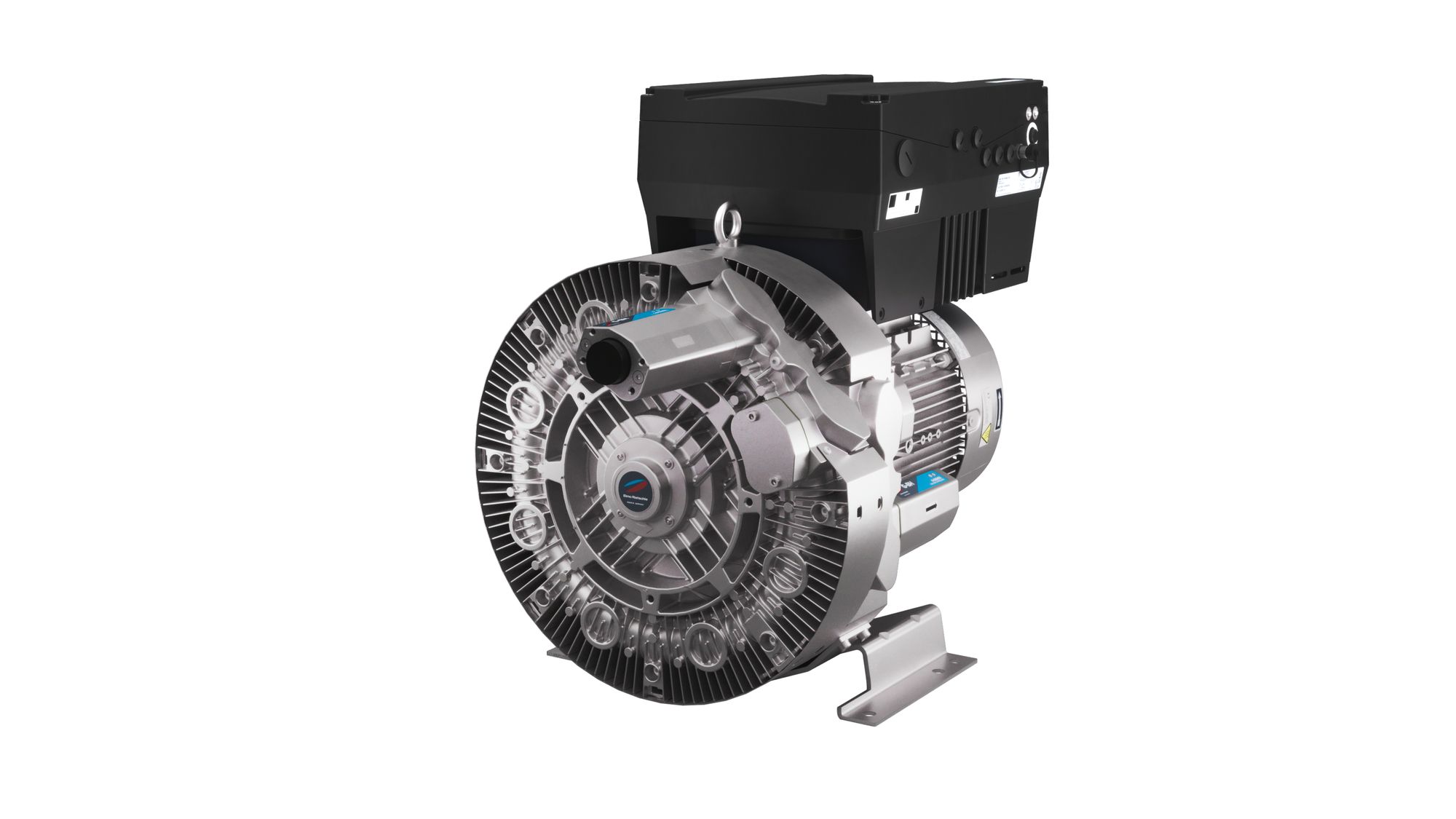
Elmo Rietschle 2BH7420
Elmo Rietschle 2BH7420 — Side-Channel / Regenerative Ring Blowers with Max. differential pressure -270 mbar, Motor power 3.5 kW, Noise level 77 dB.
The 2BH7420 is a side-channel blower from the Elmo Rietschle G-BH7 series, supplied with an integrated frequency converter (type 2FC4302-1) and a 3.0 kW motor configured for delta connection at 345 V / 87 Hz. It delivers vacuum down to -270 mbar and pressure up to 200 mbar, distinguishing it from smaller siblings (2BH7210, 2BH7220) by its higher power rating and integrated VFD. It is intended for continuous-duty vacuum or pressure generation in industrial processes where variable speed control and a compact, IP55-protected package are required.
Elmo Rietschle G-BH7 Series — Model Comparison & Selection
| Model | Motor power, kW | Noise level, dB | Max. differential pressure, mbar | Weight, kg | Current, A | Voltage, V |
|---|---|---|---|---|---|---|
| 2BH7420 Current | 2.9 | 77 | -270 | 45 | 6.5 | 380 |
| 2BH721 | 1 | 59 | -300 | 21 | 4.2 | 190–210 |
| 2BH7210 | 0.63 | 63 | -270 | 16 | 3.0 △ / 1.7 Y | 220-275 △ / 380-480 Y |
| 2BH722 | 1.1 | 58 | 480 | 28 | 4.8 UU / 2.4 U | 190-210 UU / 380-420 U |
| 2BH7220 | 0.81 | 58 | -440 | 24 | 4 | 220-275 / 380-480 Y |
| 2BH731 | 1.1 | 63 | -340 | 24 | 2.8–5.5 | 190-210 / 380-420 |
| 2BH7310 | 0.63 | 58 | 250 | — | 2.8 | 200-240 / 345-415 Y |
| 2BH732 | 1.3 | 64 | 440 | 33 | 3.2 | 190-210 / 380-420 |
| 2BH7320 | 3.5 | 77 | -510 | 48 | 6.5 | — |
| 2BH741 | 1.3 | 63 | — | 26 | 6.3 | 190–210 |
| 2BH7410 | 2.6 | 73 | -230 | 33 | 5.2 | 400 |
| 2BH742 | 1.8 | 64 | 460 | 38 | 3.9–7.8 | 190-210 / 380-420 |
| 2BH751 | 1.8 | 68 | -340 | 33 | 7.8 UU | 190-210 UU / 380-420 U |
| 2BH7510 | 6.6 | 78 | 430 | 43 | 12.7 | 400 |
| 2BH752 | 2.5 | 64 | -520 | 50 | 12 | 190-210 / 380-420 |
| 2BH7520 | 4.3 | 77 | -520 | 57 | 8.7 | 400 V (-15%) … 480 V (+1 |
| 2BH753 | 5.3 | 69 | 950 | 72 | 17.1 | 190–210 |
| 2BH7530 | 7.5 | 70 | -610 | 80 | 16.2 | 400 |
| 2BH7610 | 5.8 | 80 | -410 | 55 | 12.7 | 380 |
| 2BH7620 | 8.8 | 79 | -530 | 77 | 16.2 | 400 |
| 2BH7630 | 16 | 80 | -500 | 121 | 29 | 400 |
Full specifications
| Max. differential pressure | -270 mbar (100 Hz) 87 Hz: -400 mbar |
| Motor power | 3.5 kW (100 Hz) 87 Hz: 2.9 kW |
| Noise level | 77 dB (100 Hz) 87 Hz: 77 dB |
| Order No. mfr | 2BH7420-0A321-1 |
| Vacuum mfr | -270 mbar |
| Motor connection mfr | delta |
| Max. differential pressure (alt 100 Hz) mfr | 800 mbar (100 Hz) |
| Max. differential pressure vacuum (alt 100 Hz) mfr | -580 mbar (100 Hz) |
| Max. differential pressure (alt 87 Hz) mfr | 930 mbar (87 Hz) |
| Max. differential pressure vacuum (alt 87 Hz) mfr | -620 mbar (87 Hz) |
| Weight | 45 kg (100 Hz) 87 Hz: 45 kg |
| Weight (alt 100 Hz) mfr | 57 kg (100 Hz) |
| Weight (alt 87 Hz) mfr | 57 kg (87 Hz) |
| Current | 6.5 A (100 Hz) 87 Hz: 6.1 A |
| Frequency | 100 Hz |
| Power supply | 3~ 400V -15% … 480V +10%, 50/60 Hz ±6% |
| Voltage | 400 V (100 Hz) 87 Hz: 380 V |
| Rated mains voltage mfr | 400V (-15%) ... 480V (+10%) V |
| Max. motor current mfr | 16 A |
| Typical motor power mfr | 3.0 kW |
| Rated mains current mfr | 5.0 A |
| Fuse Protection mfr | 10 A |
| Frequency Converter mfr | 2FC4302-1 |
| VFD rated voltage/frequency set point mfr | 345 V / 87 Hz |
| Minimum mains voltage for frequency converter mfr | 380 V |
| Pulse frequency (minimum) mfr | 4 kHz |
| Rated voltage mfr | 345 V (VFD set point at 87 Hz) |
| Current (alt 100 Hz) mfr | 12.7 A (100 Hz) |
| Power (alt 100 Hz) mfr | 6.9 kW (100 Hz) |
| Current (alt 87 Hz) mfr | 11.8 A (87 Hz) |
| Power (alt 87 Hz) mfr | 5.8 kW (87 Hz) |
| Protection rating | IP55 |
| Operating temperature | 25 degC |
| Sound pressure level mfr | 77 dB(A) |
| Sound pressure level (alt 100 Hz) mfr | 80 dB (100 Hz) |
| Sound pressure level (alt 87 Hz) mfr | 80 dB (87 Hz) |
Description
Construction and series positioning
- The 2BH7420 is a regenerative (side-channel) blower with an integrated frequency converter mounted on the motor terminal box. The motor is wound for delta connection and rated for 345 V / 87 Hz when driven by the converter, allowing operation from a 400 V mains supply without a separate transformer.
- Within the G-BH7 series, the 2BH7420 sits above the 2BH7210 and 2BH7220 in terms of motor power (3.0 kW typical) and achievable pressure/vacuum. The integrated converter is a key differentiator: sibling models may be supplied without a built-in VFD, requiring external speed control.
- The unit is protected to IP55 and uses insulation class F, making it suitable for dusty or damp industrial environments where washdown is not required.
Performance and operating envelope
- Maximum vacuum is -270 mbar and maximum pressure is 200 mbar. These limits are absolute and should not be exceeded even momentarily, as the side-channel impeller and bearings are designed for these differential pressures.
- The motor is rated 3.0 kW typical, with a maximum current of 16 A and a rated mains current of 5.0 A at 400 V / 50 Hz. The frequency converter allows speed adjustment, but the VFD set point must be programmed to 345 V / 87 Hz to match the motor winding; incorrect V/f settings can cause overheating or loss of torque.
- Sound pressure level is 77 dB(A) at 1 m free field. This should be considered when locating the blower near operator areas.
Installation, connection and control
- The blower is designed for horizontal mounting on a flat, vibration-free surface. The integrated converter requires a 400 V (-15%) to 480 V (+10%) three-phase supply with a minimum fuse protection of 10 A. The minimum mains voltage for the converter is 380 V; below this, the VFD may trip or derate.
- Motor connection is delta, and the converter output must be set to 345 V / 87 Hz. The pulse frequency must be at least 4 kHz to avoid excessive motor heating and acoustic noise.
- The converter is pre-wired to the motor; only mains and control signals need to be connected. Control terminals accept 0–10 V or 4–20 mA speed reference (refer to converter manual for terminal assignment).
- The blower is not supplied with a suction or discharge silencer, filter, or flexible connectors; these must be ordered separately and installed to avoid transmitting vibration to pipework.
Integration & Operating Notes
The motor is protected by a 10 A fuse (class gG or equivalent). The maximum motor current is 16 A, but this is a short-time limit; continuous operation above the rated 5.0 A at 400 V will cause thermal overload. Ensure the supply and protection devices are sized for the starting current of the VFD-driven motor, which is limited by the converter's ramp settings.
The motor is wound for delta connection and must be operated with a V/f characteristic of 345 V at 87 Hz. The pulse frequency must be at least 4 kHz to limit harmonic losses and acoustic noise. Incorrect settings will lead to overheating, reduced torque, or converter faults. Verify these parameters after any converter replacement or reset.
The blower is designed for continuous operation within these differential pressure limits. Exceeding them can cause excessive temperature rise, bearing overload, and mechanical damage. If the process requires higher pressure or vacuum, a larger model or a multi-stage arrangement must be selected. Install a pressure relief valve or bypass to protect against overpressure.
Selection & Integration Q&A
Choose the 2BH7420 when your process requires vacuum down to -270 mbar or pressure up to 200 mbar and you need an integrated VFD for speed control. The 2BH7220 has lower power and pressure capability, so it is suitable only for less demanding applications.
The converter requires a 400 V (-15%) to 480 V (+10%) three-phase supply, with a minimum voltage of 380 V. Use a 10 A fuse (gG or equivalent) for protection. The motor must be connected in delta and the VFD set to 345 V / 87 Hz with a minimum pulse frequency of 4 kHz. Ensure the supply can handle the starting current, which is limited by the VFD ramp.
The base delivery excludes suction filters, silencers, flexible connectors, and pressure relief valves. These must be ordered separately. Maintenance includes checking bearings every 10,000 hours, cleaning cooling passages, and verifying VFD settings. The frequency converter requires no routine maintenance but should be kept clean and dry. Refer to the manual for spare parts.