
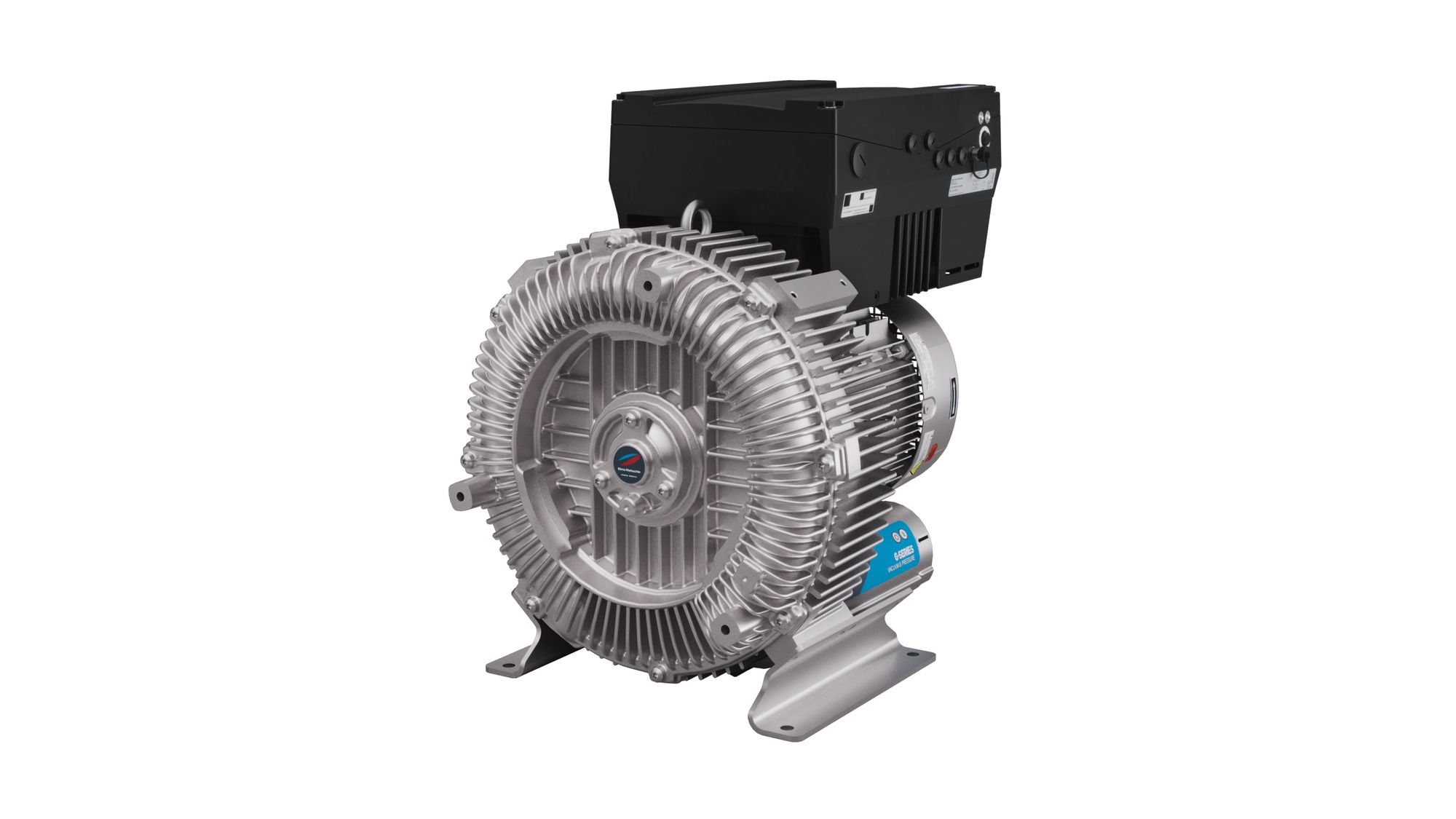
Elmo Rietschle 2BH1930
Elmo Rietschle 2BH1930 — Side-Channel / Regenerative Ring Blowers with Max. differential pressure -120 mbar, Motor power 8.6 kW, Noise level 75 dB.
The 2BH1930 is a side-channel regenerative blower in Elmo Rietschle's G-BH1 series, a single-stage, directly driven unit with an IE3 motor and IP55 protection. It delivers up to 370 mbar differential pressure in pressure mode and -320 mbar in vacuum at 50 Hz, distinguishing it as the largest and highest-pressure modification among the 2BH10xx siblings. It is intended for continuous industrial service in pneumatic conveying, vacuum holding, or low-pressure compression where oil-free, contact-free operation is required.
Elmo Rietschle G-BH1 Series — Model Comparison & Selection
| Model | Motor power, kW | Noise level, dB | Weight, kg | Max. differential pressure, mbar | Current, A | Protection rating |
|---|---|---|---|---|---|---|
| 2BH1930 Current | 8.6 | 75 | 212 | -80 | 17.6–35.2 | IP55 |
| 2BH1009 | — | — | — | — | — | — |
| 2BH1014 | 0.32 | 57 | 11 | -55 | 3.2–6.5 | IP55 |
| 2BH1015 | 1.3 | 64 | 21 | -180 | 8–16 | IP55 |
| 2BH1023 | 1.75 | 69 | 69 | -190 | 10–20 | IP55 |
| 2BH1035 | 2.2 | 64 | 70 | -140 | 14.3–27 | IP55 |
| 2BH1100 | 0.2 | 53 | 10 | -120 | 1.39 Δ / 0.80 Y | IP 55 |
| 2BH1200 | 0.29 | 40 | 57 | -40 | 1.38 0.8 Y | IP55 |
| 2BH1300 | 0.29 | 100 | 51 | -100 | 1.9 | IP 55 |
| 2BH1310 | 0.7 | 56 | 16 | -250 | 3.8 Δ / 2.20 Y | IP55 |
| 2BH1330 | 0.29 | 80 | 51 | — | 1.74 Δ / 1.0 Y | IP55 |
| 2BH1400 | 0.95 | 61 | 16 | -180 | 5.6 | IP55 |
| 2BH1410 | 2 | 65 | 28 | -300 | 6.9 | IP55 |
| 2BH1430 | 1.1 | 64 | 16 | 110 | 4.2 | IP55 |
| 2BH1490 | 0.95 | 61 | 16 | -140 | 4.8 VV | IP55 |
| 2BH1500 | 0.95 | 65 | 21 | -90 | 4.2 | IP55 |
| 2BH1510 | 4 | 71 | 48 | -400 | 7.6–15.2 | IP55 |
| 2BH1530 | 1.6 | 69 | 25 | -90 | 4.7 | IP55 |
| 2BH1590 | 1.3 | 61 | 21 | -190 | 2.75 | IP55 |
| 2BH1600 | 1.75 | 72 | 31 | 130 | 9.9 | IP55 |
| 2BH1610 | 2.5 | 75 | 48 | 160 | 6 | IP55 |
| 2BH1630 | 2.5 | 64 | 36 | -160 | 17.1 | IP55 |
| 2BH1640 | 4.6 | 65 | 65 | -240–260 | 17.1 | IP55 |
| 2BH1690 | 2.5 | 64 | 34 | -200 | 9.9 | IP55 |
| 2BH1800 | 5.8 | 77 | 131 | 260 | 11–22 | IP55 |
| 2BH1810 | 9.9 | 74 | 188 | -460 | 30.8 | IP55 |
| 2BH1830 | 5.8 | 75 | 133 | -160 | 19.4 | IP55 |
| 2BH1900 | 8.6 | 71 | 183 | -190 | 30.8 | IP55 |
| 2BH1910 | 12.6 | 76 | 295 | -220 | 26.4 | IP55 |
| 2BH1940 | 19.9 | 73 | 303 | -150 | 63.1 | IP55 |
| 2BH1943 | 17.3 | 77 | 330 | -160 | 72.2 UU / 36.1 U | IP55 |
Full specifications
| Max. differential pressure | -120 mbar (50 Hz) 60 Hz: -80 mbar |
| Motor power | 8.6 kW (50 Hz) 60 Hz: 9.9 kW |
| Noise level | 71 dB (50 Hz) 60 Hz: 75 dB |
| Max. differential pressure vacuum mfr | -80 mbar (60 Hz) |
| Order No. mfr | 2BH1930-1AK01 |
| Max. differential pressure (pressure) (alt 50 Hz) mfr | 110 mbar (50 Hz) |
| Max. differential pressure (pressure) (alt 60 Hz) mfr | 70 mbar (60 Hz) |
| Weight | 212 kg |
| Number of stages | 1 |
| Current | 30.8 A (50 Hz) 60 Hz: 35.2 / 17.6 A |
| Frequency | 50/60 Hz |
| Power supply | 3~ 50/60 Hz |
| Voltage | 190-210 V (50 Hz) 60 Hz: 190-210 / 380-420 V |
| Efficiency class mfr | IE3 (50 Hz) |
| Rated frequency mfr | 60 Hz (60 Hz) |
| Efficiency class mfr | IE3 / NP (60 Hz) |
| Rated voltage mfr | 200 V (60 Hz) |
| Rated current mfr | 35.2 A (60 Hz) |
| Rated power mfr | 9.9 kW (60 Hz) |
| Protection rating | IP55 |
| Operating temperature | 25 degC |
| Sound pressure level mfr | 71 dB(A) (50 Hz) |
| Sound pressure level mfr | 75 dB(A) (60 Hz) |
Description
Construction and series positioning
- The 2BH1930 is a single-stage side-channel blower with a directly coupled IE3 induction motor, housed in a compact, fan-cooled enclosure rated IP55.
- Within the G-BH1 series, the 2BH10xx family includes smaller models (2BH1009, 2BH1014, 2BH1015, 2BH1023); the 2BH1930 is the largest, with a 21.3 kW motor at 50 Hz and a weight of approximately 340 kg.
- It is designed for both pressure and vacuum duty, with maximum differential pressures of 370 mbar and -320 mbar respectively at 50 Hz.
Performance and operating behavior
- At 50 Hz, the unit delivers 21.3 kW shaft power at 38.3 A (delta) or 22.1 A (star) from a 380–420 V D / 660–725 V U supply; at 60 Hz, 24.5 kW at 38.0 A from 440–480 V.
- Maximum differential pressure is slightly higher in pressure mode (370 mbar) than vacuum mode (-320 mbar) at 50 Hz; at 60 Hz, both are 340 mbar.
- Sound pressure level is 74 dB(A) at 50 Hz and 78 dB(A) at 60 Hz, measured at typical operating conditions.
- The blower is oil-free and contact-free, with no internal lubrication or wear parts in the gas path, making it suitable for continuous duty.
Installation and operation
- The motor is rated for IE3 efficiency and insulation class F, with IP55 protection, allowing outdoor installation with appropriate shielding.
- Direct coupling eliminates belt maintenance; the blower can be mounted in any orientation, but must be secured to a rigid foundation to avoid vibration.
- Electrical connection requires a suitable motor starter or variable frequency drive (VFD) rated for the full load current; the 60 Hz data indicates dual-frequency capability, but the motor must be configured for the actual supply.
- No specific PDF manual was provided; general installation and maintenance guidelines for the G-BH1 series apply.
Integration & Operating Notes
The motor is wound for dual voltage (380–420 V delta / 660–725 V star at 50 Hz; 440–480 V at 60 Hz). Incorrect connection will cause excessive current or reduced torque, leading to overheating or failure. Verify the terminal box link configuration against the actual supply before first start.
Exceeding the maximum differential pressure can cause motor overload, excessive temperature rise, or mechanical damage. The limit is 370 mbar at 50 Hz and 340 mbar at 60 Hz; for vacuum duty, the corresponding limits are -320 mbar and -340 mbar. Install a pressure relief valve or monitor differential pressure to stay within these bounds.
The 340 kg mass and direct-coupled motor generate vibration if not properly supported. Use a flat, rigid base with anti-vibration mounts if necessary. Ensure the mounting surface can withstand the static and dynamic loads, and check alignment after installation to prevent bearing wear.
The IP55 rating protects against dust and water jets, but prolonged exposure to direct sunlight or extreme temperatures may affect motor insulation and bearing life. Provide a sunshade or enclosure if installed outdoors, and ensure ambient temperature stays within the motor's rated range (typically -20 to +40 °C).
Although the blower is oil-free, dust and debris can accumulate on the impeller and in the inlet, reducing performance and causing imbalance. Inspect every 500 operating hours or more frequently in dusty environments. Clean with compressed air or a soft brush; do not use solvents that may damage the impeller.
Selection & Integration Q&A
Choose the 2BH1930 when your process requires differential pressures up to 370 mbar or vacuum to -320 mbar at flow rates that would overload smaller models. The 2BH1023 and 2BH1015 offer lower maximum pressures and are suited for lower-demand applications; the 2BH1930 provides the highest pressure and power in the 2BH10xx family.
Use a starter or VFD rated for at least 38.3 A at 380–420 V (50 Hz) or 38.0 A at 440–480 V (60 Hz), with overload protection set to the motor's full load current. The IE3 motor can be operated with a VFD for speed control, but ensure the drive is configured for the motor's insulation class F and that cable lengths and shielding meet EMC requirements.
Yes, the IP55 rating permits outdoor installation, but the motor's ambient temperature range (typically -20 to +40 °C) must be observed. Provide a sunshade and ensure adequate ventilation; if temperatures exceed 40 °C, derating or additional cooling may be necessary. Avoid direct exposure to rain and snow unless additional covers are used.
The base delivery includes the blower and motor only. You must separately source inlet filters, silencers, flexible connectors, pressure relief valves, and mounting feet if required. A spare parts kit (bearings, seals) and a vibration monitoring system are recommended for critical installations. Refer to the series manual for specific accessory part numbers.